
Scientists model Mars’ giant cloud, uncovering rare atmospheric process
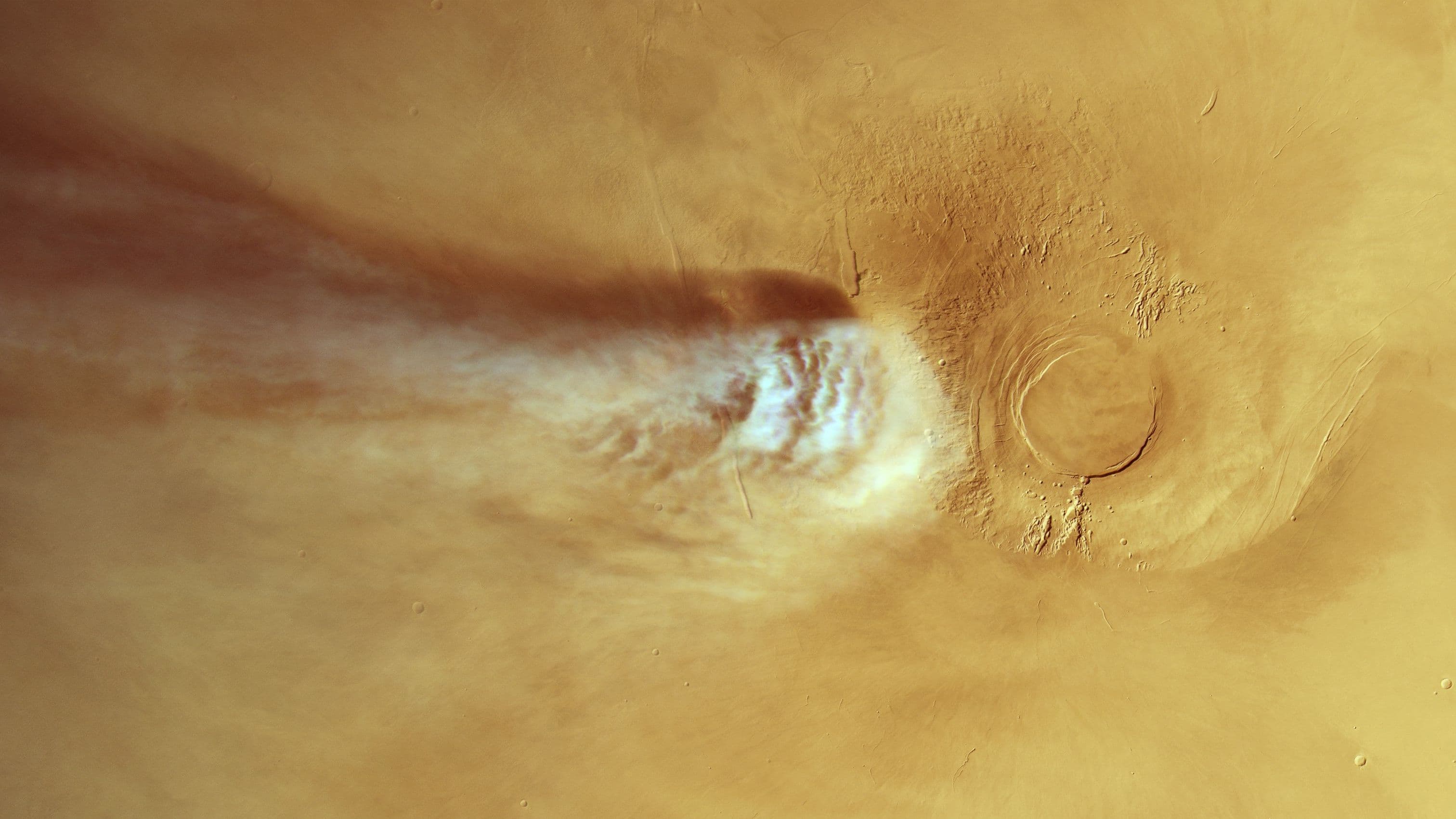
Researchers at Sorbonne Université have successfully modeled the formation of the Arsia Mons Elongated Cloud (AMEC) on Mars, revealing a physical process never before observed in any planet’s atmosphere. The findings, which rely on extreme conditions and exotic physics, could reshape understanding of planetary atmospheres and their behavior.

Editor, Lazyfounder
How the cloud forms
The Arsia Mons Elongated Cloud (AMEC), first observed in 2018, has puzzled scientists until now. A team led by planetary scientist Jorge Hernández-Bernal at Sorbonne Université has modeled its formation, identifying a rare physical process called homogeneous nucleation as the likely driver. This process, which has never been directly observed in any planet’s atmosphere, requires extreme conditions: a 30°C temperature drop within 10 minutes and humidity levels 100,000 times greater than those measured on Earth.
The Arsia Mons volcano plays a central role in this phenomenon. It creates a powerful atmospheric wave that lifts moist air to high altitudes, where the extreme conditions trigger cloud formation. The study suggests that such processes might also occur in the upper atmospheres of other planets, including Venus, though they have never been observed.
Why this matters for planetary science
This research marks the first successful modeling of homogeneous nucleation in a planetary atmosphere. The findings challenge existing assumptions about atmospheric physics and could inform future studies of Mars and other planets. Understanding such processes may also refine climate models and improve predictions of atmospheric behavior in extreme conditions.
The study highlights the limitations of current observational tools, as the required humidity levels and temperature fluctuations had not been previously detected on Mars. This suggests that other unexplained atmospheric phenomena on Mars or elsewhere might involve similarly rare processes.
What this means
Lazyfounder analysis — our interpretation, not reported fact.
For founders and operators in space technology or atmospheric research, this discovery signals a shift in how planetary atmospheres are understood. The rare physical process behind AMEC’s formation could inspire new approaches to modeling extreme atmospheric conditions, not just on Mars but on other planets. Companies working on climate modeling, satellite technology, or planetary exploration may find opportunities to refine their tools or expand their research focus to include these exotic phenomena.
Related on Lazyfounder
Sources
- WIRED · 2026-10-23
The ‘Exotic Physics’ Behind a Mysterious 1,000-Mile Cloud on Mars
This story is an original summary drafted with AI by Lazyfounder from the reporting listed above and checked by automated validation. Facts are attributed to their original publishers; sections marked as analysis are Lazyfounder's. Where a source is in another language, facts were machine-translated and quotations are reported, not reproduced. Read the original coverage via the links, and see our AI policy and corrections policy.

About the author
Editor, Lazyfounder
Tarun Mottlia edits LazyFounders, covering Indian startups, funding rounds, AI and product launches. Every story on the site is AI-assisted and checked against its cited sources before publication.
More stories by Tarun MottliaGet the LazyFounder Brief
Startup, funding and AI news in a five-minute read. Join the early-access list.
