

Sarvam AI expands into full-stack AI for Indian enterprises
Sarvam AI has moved beyond building Indian-language models to offer a full-stack AI suite for enterprises. According to Inc42, the startup now bundles foundation models, infrastructure, coding tools, voice agents, and workplace applications, positioning itself as an alternative to global players like OpenAI and Anthropic.

Editor, Lazyfounder
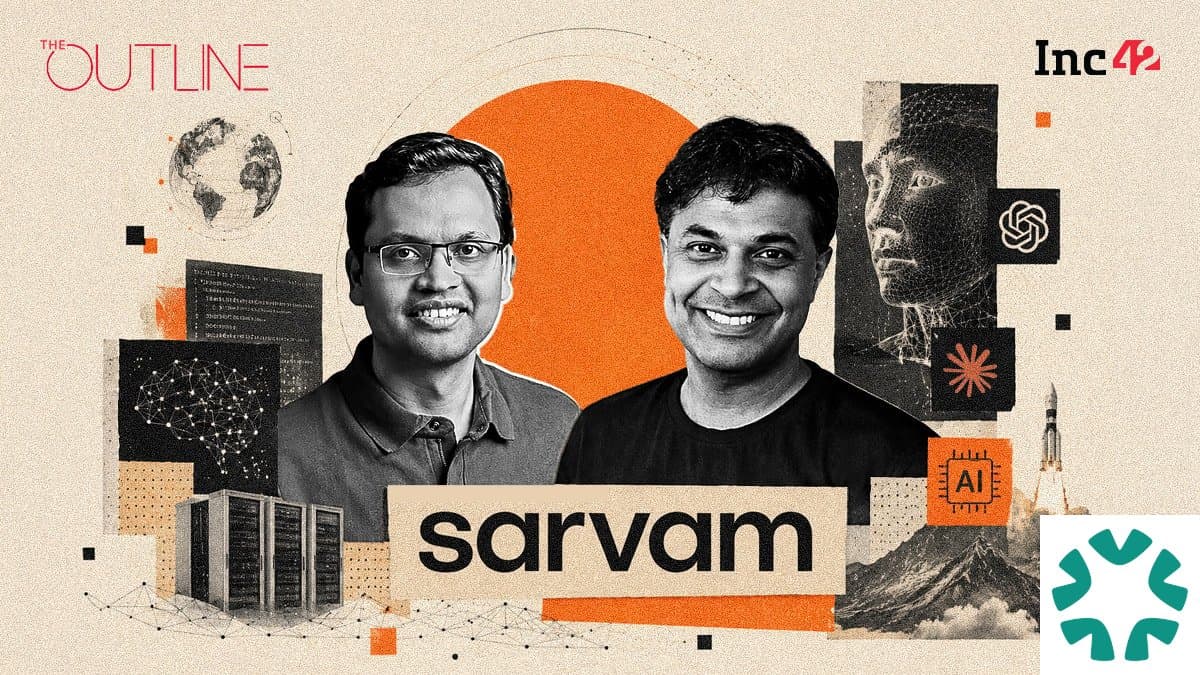
TABLE OF CONTENTS
From language models to a full-stack AI provider
According to Inc42, Sarvam AI has expanded its ambition beyond Indian-language foundation models to become a full-stack AI venture. The startup now offers a range of products covering foundation models, infrastructure, coding copilots, voice agents, document intelligence, and workplace applications.
This shift follows a $234 Mn Series B round in June that valued the company at $1.5 Bn, pushing it into India’s unicorn club. Sarvam’s inaugural developer conference, Sarvam Epoch, marked the public launch of this broader vision.
What Sarvam is building
Sarvam’s full-stack approach includes several layers. At the infrastructure level, Sarvam Inference is an India-hosted platform for running open-weight models, supporting both its own 105 Bn-parameter model and third-party models like GLM 5.2 and Gemma 4. The startup is also developing a trillion-parameter model.
On the application front, Sarvam offers Sarvam Code, a coding agent that scored 72 out of 89 on Terminal Bench, ahead of some models used by Claude Code. Its Saaras V4 speech model supports all 22 constitutional Indian languages, while Samvaad, its voice platform, has processed 325 Mn minutes of customer conversations in the past year. Other tools include Sarvam Work for workplace tasks, Vision for document processing, and Anvaya for defence and national security use cases.
Sarvam has also introduced hardware, including Kaze, its smart glasses, and Kivi, a desktop app for dictation.
Why Sarvam is betting on the full stack
According to Inc42, Sarvam’s strategy aims to capture a significant share of India’s AI consumption by addressing key enterprise concerns: pricing, reliability, data security, and sovereignty. By hosting infrastructure in India, Sarvam targets government departments, defence organisations, and regulated businesses that require sensitive data to remain within the country.
The startup argues that its integrated stack—spanning models, infrastructure, and applications—allows it to optimise for cost and performance. For example, its Samvaad voice platform is priced at ₹3.5 per minute, compared to an industry range of ₹8-12, while its 105B model is positioned as cheaper than comparable offerings from Google and OpenAI.
Sarvam’s linguistic focus is another differentiator. Saaras V4 supports all 22 constitutional Indian languages, including those with limited training data, and is designed to handle code-switching in real conversations.
The challenge: convincing enterprises to switch
Inc42 reports that while Sarvam’s benchmarks show competitive performance—such as Sarvam Work scoring 79% on HarnessBench and Sarvam Code outperforming some Claude Code models—enterprise adoption depends on more than numbers. Engineering teams often rely on established tools like Claude Code or Codex, which are already embedded in workflows.
An AI founder quoted in the source noted that switching to a new tool like Sarvam Code may not justify the disruption for teams already using alternatives. Enterprise buyers, particularly CIOs, will evaluate whether Sarvam’s products integrate with existing systems and deliver enough value to offset the cost of migration.
Sarvam’s pitch for data sovereignty and local hosting could resonate with highly regulated sectors, but the startup must still prove that its full-stack approach can match or exceed the reliability and ecosystem support of global players like OpenAI and Anthropic.
Competitive landscape and implications for founders
Sarvam’s expansion positions it as a direct competitor to startups offering niche AI tools, such as coding assistants, voice agents, or document processors. Its ability to bundle models, infrastructure, and applications under one roof may pressure single-product startups to differentiate on cost, integration, or compliance.
For Indian enterprises, Sarvam’s pitch could accelerate AI adoption by addressing concerns about data sovereignty and pricing. Founders building for Indian businesses may need to align their stacks with Sarvam’s ecosystem or risk losing ground to enterprises that prefer an all-in-one vendor.
The startup’s hardware ventures, like smart glasses and dictation apps, signal an intent to compete beyond software, potentially challenging companies in wearables and productivity tools.
What this means
Lazyfounder analysis — our interpretation, not reported fact.
Sarvam AI’s shift from building Indian-language models to a full-stack AI provider is a signal for founders and operators in India’s enterprise tech space.
For startups offering niche AI tools—whether coding assistants, voice agents, or document processors—the move turns Sarvam from a potential partner into a direct competitor. Its ability to bundle models, infrastructure, and applications under one roof could make it harder for single-product startups to compete on cost, integration, or data sovereignty, especially in regulated sectors like finance, healthcare, and government.
For enterprise buyers, Sarvam’s pitch is about reducing reliance on global players like OpenAI or Anthropic by offering a locally hosted, cheaper, and linguistically tailored alternative. This could accelerate adoption of AI in Indian enterprises, particularly those hesitant about offshore data storage. Founders building for Indian businesses may need to reconcile their own stacks with Sarvam’s growing ecosystem—or risk being sidelined by enterprises that prefer an all-in-one vendor.
The bet also underscores the strategic value of vertical integration in AI. By controlling the model, infrastructure, and application layers, Sarvam aims to optimise for cost and performance in ways that modular competitors cannot. Startups that rely on third-party models or cloud providers may find themselves at a disadvantage if Sarvam’s integrated approach delivers better economics or compliance guarantees.
Sources
- inc42.com · 2026-08-02
Sarvam’s AI Arsenal
This story is an original summary drafted with AI by Lazyfounder from the reporting listed above and checked by automated validation. Facts are attributed to their original publishers; sections marked as analysis are Lazyfounder's. Where a source is in another language, facts were machine-translated and quotations are reported, not reproduced. Read the original coverage via the links, and see our AI policy and corrections policy.

About the author
Editor, Lazyfounder
Tarun Mottlia edits LazyFounders, covering Indian startups, funding rounds, AI and product launches. Every story on the site is AI-assisted and checked against its cited sources before publication.
More stories by Tarun MottliaGet the LazyFounder Brief
Startup, funding and AI news in a five-minute read. Join the early-access list.
