
Agrograde builds optical sorters for onions and potatoes, raises $170K
Agrograde, a Pune-based startup operating as Occipital Technologies, has developed optical sorting machines designed to grade onions and potatoes by quality rather than size. The company, founded in 2017, has raised approximately ₹1.5 crore ($170,000) across three funding rounds and deployed 130 machines across 14 Indian states.

Editor, Lazyfounder
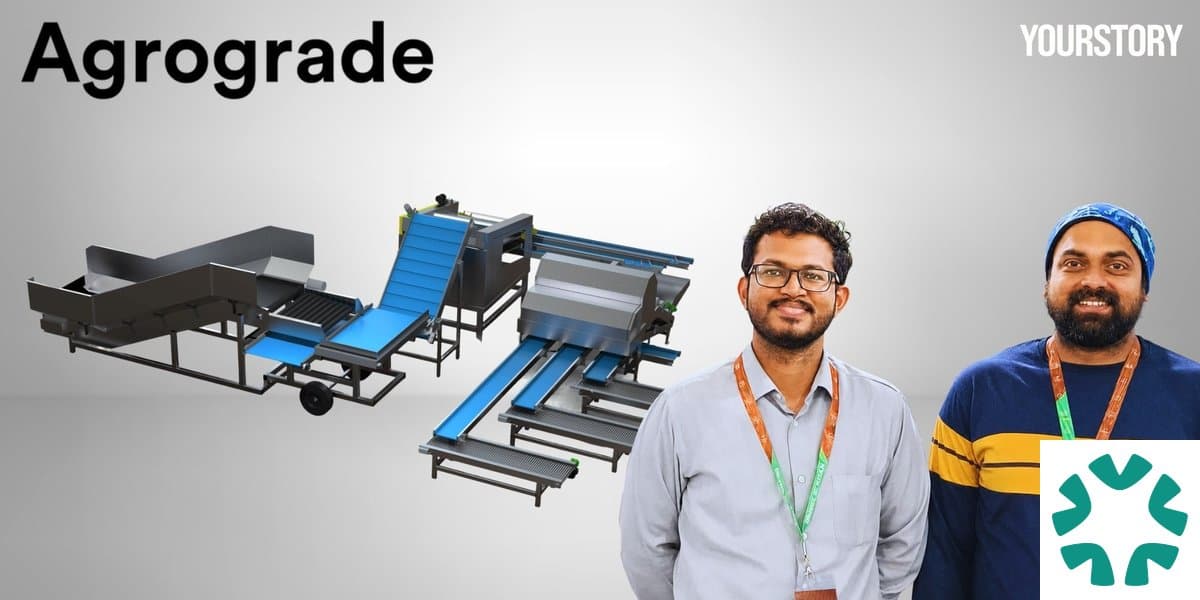
TABLE OF CONTENTS
KEY HIGHLIGHTS
- Agrograde, operating as Occipital Technologies, builds optical sorting machines for onions and potatoes, grading by quality instead of size.
- Founded in 2017 by Kshitij Thakur and Rakeshkumar Barai, the company is headquartered in Pune with manufacturing in Chakan.
- The startup has raised approximately ₹1.5 crore ($170,000) across three funding rounds, with the latest in July 2022.
- Agrograde’s machines are deployed across 14 Indian states and four crops, with 130 units in operation.
- The company is raising a pre-Series A round to expand manufacturing and develop autonomous packhouse operations.
- Backers include Social Alpha, Villgro, CIIE.CO, and Aligned Partners Venture Services.
What the machines do
Agrograde’s machines sort onions and potatoes based on quality metrics like texture, boundaries, and defects, rather than relying solely on size or color. The company’s Vector Series platform uses optical analysis to distinguish natural variations from defects, a challenge for conventional color sorters when handling unwashed, mixed-variety produce.
The technology is crop-specific. For instance, the WaveMotion system grades onions using a wave-like motion designed to avoid damaging the outer skin, while the roller geometry is adjusted to prevent snapping elongated potato varieties. According to the company, the system achieves up to 96% defect detection accuracy and does not require recalibration when switching between potato varieties.
Funding and growth
Agrograde has raised about $170,000 across three funding rounds, with the first in 2019 and the most recent in July 2022. The startup reports annual turnover between ₹1.5 crore and ₹5 crore, with a team of 11 to 25 employees.
The company’s backers include development-focused investors such as Social Alpha, Villgro, CIIE.CO, and Aligned Partners Venture Services. As of July 2026, Agrograde is raising a pre-Series A round to expand manufacturing capacity and develop autonomous packhouse operations, starting with onion and potato supply chains where its machines are already in use.
Market context
Agrograde addresses a gap in India’s post-harvest supply chain, where over 99% of packhouses still rely on manual grading, according to the company. This manual process is prone to inconsistencies, leading to disputes, rejected consignments, and financial losses for farmers and traders.
The startup’s founder, Kshitij Thakur, has noted that the existing workforce in packhouses is aging, with an average age over 45, and that current infrastructure cannot meet demands for scale and consistency. He also highlights that imported sorting machines often fail in Indian conditions due to incompatibility with local crop varieties and handling requirements.
Deployment and recognition
Agrograde has deployed 130 machines across 14 Indian states, covering four crops. The company has been recognized as a top agritech startup in Mahindra’s Startup Leap 2023, included in NITI Aayog’s compendium of 75 agricultural innovators, and named national runner-up in the MANAGE Samunnati awards in 2022.
What this means
Lazyfounder analysis — our interpretation, not reported fact.
Agrograde’s work highlights two realities for founders in agri-tech hardware. First, the market opportunity in India’s post-harvest sector is large but fragmented, with entrenched manual processes. Startups that solve for consistency—like optical sorting—can reduce disputes and improve trust in supply chains, which is critical for formalizing trade. Second, the company’s slow, hardware-focused path shows that agri-tech ventures may need to prioritize revenue generation early, rather than relying on venture capital alone. This is especially true for startups addressing niche problems, like crop-specific grading, where off-the-shelf solutions from global manufacturers fail.
For operators in agriculture or supply chain tech, Agrograde’s trajectory is a signal that automation in Indian agriculture is not just about tractors or drones. Quality grading is a bottleneck that affects pricing, storage, and exports, and solving it at scale could unlock new efficiencies. The challenge, however, is adoption: packhouses and farmer-producer organizations need financing and proximity to grading infrastructure to make the shift. Startups that can bundle hardware with financing or leasing models may have an edge.
Key takeaways
- Post-harvest technology is a fragmented market in India, with manual grading creating inefficiencies and disputes in supply chains. Agrograde’s machines address this gap with crop-specific automation.
- Hardware startups in agriculture face long development cycles and modest funding. Agrograde’s approach—selling machines from the outset—may offer a template for capital efficiency in the sector.
- The company’s focus on autonomy in packhouses could redefine quality control in agriculture, starting with high-volume crops like onions and potatoes.
- Agrograde’s recognition by NITI Aayog and MANAGE signals credibility for startups targeting policy-relevant challenges in agriculture.
Sources
This story is an original summary drafted with AI by Lazyfounder from the reporting listed above and checked by automated validation. Facts are attributed to their original publishers; sections marked as analysis are Lazyfounder's. Where a source is in another language, facts were machine-translated and quotations are reported, not reproduced. Read the original coverage via the links, and see our AI policy and corrections policy.

About the author
Editor, Lazyfounder
Tarun Mottlia edits LazyFounders, covering Indian startups, funding rounds, AI and product launches. Every story on the site is AI-assisted and checked against its cited sources before publication.
More stories by Tarun MottliaGet the LazyFounder Brief
Startup, funding and AI news in a five-minute read. Join the early-access list.
