
Red Balloon Aerospace builds modular near-space platforms in India
Red Balloon Aerospace, a Vijayawada-based spacetech startup, is developing stratospheric airships, balloons, and aerostats to establish India’s near-space infrastructure. The company aims to fill a gap in testing facilities for payloads before they reach orbit, using a modular platform approach and in-house manufacturing.

Editor, Lazyfounder
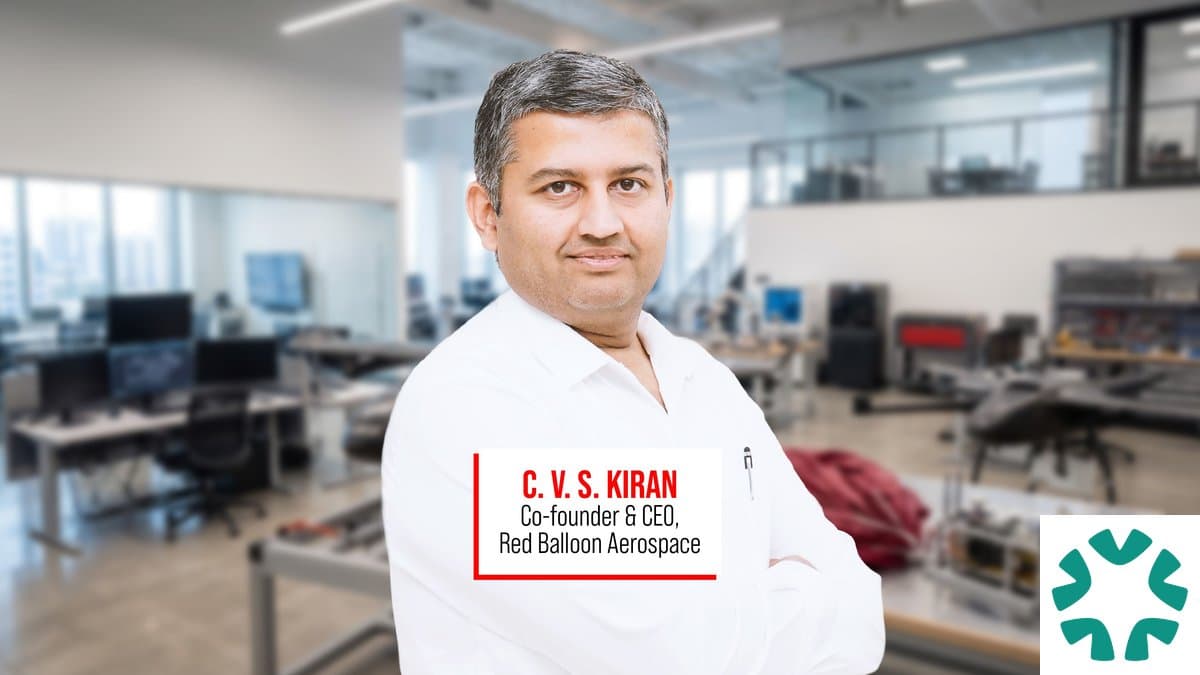
TABLE OF CONTENTS
Platforms for near-space testing
Red Balloon Aerospace is developing a suite of platforms to enable testing and operations in near-space, the region between 20 km and 50 km above Earth. The startup’s primary offering, HELIX, is an autonomous stratospheric airship designed for long-endurance missions. Alongside it, the company has launched VISTA, a super-pressure balloon, and is preparing ALTIS, a tethered aerostat, to serve as modular testbeds for subsystems that will be integrated into HELIX.
The VISTA balloon mission, launched in May from Vijayawada, demonstrated India’s indigenous capability in super-pressure stratospheric balloons, placing the country among five nations with such technology. The startup designs and manufactures its own envelope film and reinforcing structures in-house, allowing it to progress from startup to first flight in under a year.
Modular design and applications
The platforms—VISTA, ALTIS, and HELIX—are being developed as a modular family, with components like materials, avionics, navigation systems, payload interfaces, and mission software designed to be interchangeable. This approach supports applications such as communications, vehicle-to-everything (V2X) connectivity, disaster response, remote connectivity, and domain awareness.
Red Balloon Aerospace serves both commercial and government clients. For commercial customers, it uses a rideshare model, where multiple payloads share a single mission. Government applications include sovereign connectivity, earth observation, and disaster response. The startup has also secured international B2B clients, with payloads expected to fly soon.
Building near-space infrastructure in India
The company’s founder, CVS Kiran, a former scientist at Vikram Sarabhai Space Centre and ex-VP at Skyroot Aerospace, identified a gap in India’s near-space testing infrastructure. Existing facilities are oversubscribed, leading to long waitlists that delay development timelines. Kiran sees near-space as a distinct domain between aviation and satellites, offering affordability and persistence.
Kiran argues that near-space remains an underexplored category in India’s space industry, despite the country’s engineering talent, capital, and government support. He believes establishing near-space as a recognized category could unlock policy and investment opportunities. The startup’s team brings over seven decades of combined experience in lighter-than-air technology and stratospheric platforms.
Competition and funding
Red Balloon Aerospace competes with international players like World View (US) and Sceye (US). Kiran cites the company’s control over its technology stack—from envelope film to mission software—as a key advantage. The startup raised an undisclosed pre-seed round in early 2026 and is now in the process of raising a seed round, though details remain unfinalized.
The company is focused on building flight heritage for its platforms while expanding its infrastructure and team to establish near-space as a new category in India’s private space sector.
What this means
Lazyfounder analysis — our interpretation, not reported fact.
Red Balloon Aerospace’s work signals a shift in India’s spacetech sector toward near-space as a distinct infrastructure layer. For founders, this creates an early-mover opportunity in a category that bridges aviation and orbital space, with potential applications in communications, disaster response, and connectivity. The startup’s modular platform approach and in-house manufacturing could set a benchmark for others aiming to control their technology stack, reducing reliance on external suppliers. For investors, near-space infrastructure may emerge as a new funding vertical, especially as government and commercial demand for testing and deployment grows.
Sources
This story is an original summary drafted with AI by Lazyfounder from the reporting listed above and checked by automated validation. Facts are attributed to their original publishers; sections marked as analysis are Lazyfounder's. Where a source is in another language, facts were machine-translated and quotations are reported, not reproduced. Read the original coverage via the links, and see our AI policy and corrections policy.

About the author
Editor, Lazyfounder
Tarun Mottlia edits LazyFounders, covering Indian startups, funding rounds, AI and product launches. Every story on the site is AI-assisted and checked against its cited sources before publication.
More stories by Tarun MottliaGet the LazyFounder Brief
Startup, funding and AI news in a five-minute read. Join the early-access list.
