
Pronto raises $45M to train robots using real-world chore data
Pronto, an Indian startup that connects households with home-service professionals, has raised $45 million in a Series B round. The funding will help it train robots using real-world data gathered from everyday chores. The company also acquired Basilisk Industries, a Mumbai-based startup specializing in robotics perception tools, and launched Provision Labs in Silicon Valley to lead its data collection efforts. But as data collection slows and India’s new data protection law nears, privacy and regulatory risks are growing.

Editor, Lazyfounder
30 SEC SUMMARY
- Pronto, an Indian home-services startup, has secured $45 million in a Series B round led by Lachy Groom, cofounder of robotics startup Physical Intelligence.
- The company acquired Basilisk Industries, a Mumbai-based startup that builds 3D hand-tracking models and tactile gloves for robotics training.
- Pronto launched Provision Labs in Silicon Valley to gather real-world data from household chores, aiming to train general-purpose robots.
- Data collection for physical AI dropped 30% in the first half of 2026, highlighting a shortage of high-quality training datasets.
- Worker consent and privacy issues persist, particularly as India’s Digital Personal Data Protection Act takes effect in May 2027.
TABLE OF CONTENTS
- $45 million to build a robotics data pipeline
- Provision Labs: Silicon Valley’s new data hub
- From home services to AI training data
- Privacy and consent at risk
- Why high-quality data is hard to find
- A looming regulatory reckoning
- How AI is reshaping everyday services
- What this means
- Key takeaways
- Sources
$45 million to build a robotics data pipeline
Indian home-services startup Pronto has raised $45 million in a Series B round led by Lachy Groom, cofounder of robotics startup Physical Intelligence. The same week, it bought Mumbai-based Basilisk Industries, a startup that builds perception tools for robots. Basilisk’s flagship products—a 3D hand-tracking model and a lightweight tactile glove—will help capture touch and movement data for robotics training.
Provision Labs: Silicon Valley’s new data hub
To turn its vision into reality, Pronto created Provision Labs in Silicon Valley last October. The new arm will use Basilisk’s hardware and software to gather real-world data—video, spatial mapping, and touch—from everyday household tasks. Shourya Watwani, Basilisk’s founder, will lead Provision Labs’ hardware team and oversee its post-processing models.
From home services to AI training data
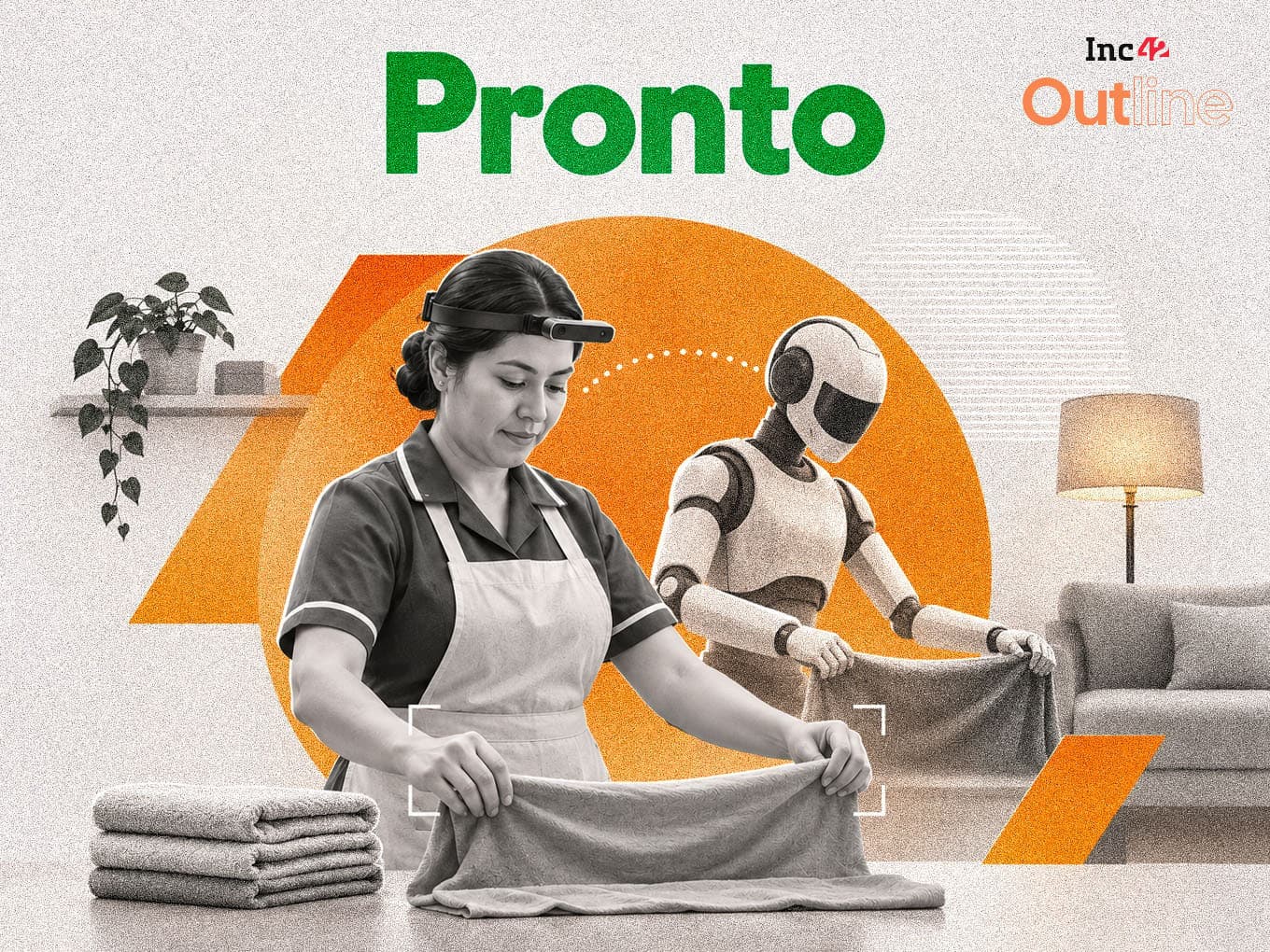
Pronto began in 2025 as a quick-commerce-style platform for home services, connecting households with trained professionals for cleaning, repairs, and other tasks. It has since served more than 500,000 households across 11 Indian cities, competing with Urban Company and Snabbit. In July 2026, Pronto launched Verified, an opt-in premium service. Workers wear cameras to record their tasks, and the footage is later used to train AI models.
Privacy and consent at risk
The shift to AI training data has raised concerns about privacy and worker consent. Pronto says it automatically blurs faces and other identifiable details in recordings, stores raw footage only until the task is complete, and anonymizes the data within 48 hours. More than half of the workers enrolled in Verified earn over ₹40,000 a month, but no independent studies have verified their satisfaction or safety.
Reports have emerged of workers in two Delhi factories being recorded without clear disclosure. The cameras, supplied by Egolab.ai, were installed without workers being told how the footage would be used. These incidents expose gaps in transparency and consent across the industry.
Why high-quality data is hard to find
General-purpose robots may need up to 10 million hours of high-quality interaction data—video, spatial, and touch—to perform real-world tasks. But between January and June 2026, data collection rates for physical AI fell 30%, revealing a critical shortage. Indian startups like Human Archive, Neocambrian AI, and Egolab.ai are racing to fill the gap, often relying on industrial settings where workers are easier to monitor.
A looming regulatory reckoning
India’s Digital Personal Data Protection Act, set to take effect in May 2027, adds a layer of risk. The law will enforce stricter rules on consent, anonymization, and data retention, potentially forcing startups to rethink their practices. For Pronto, this could disrupt its plans to scale Provision Labs just as it ramps up operations.
How AI is reshaping everyday services
Earlier Lazyfounder reporting found that parents embrace AI for household tasks but avoid tools that access sensitive data like bank records or calendars. Pronto sidesteps this issue by focusing on workforce participation, a model that reflects broader changes in the AI supply chain. Other examples include Anthropic’s Claude Personal Finance, which competes with OpenAI’s ChatGPT in financial planning, and Amazon’s text-based shopping pilot—both signs of AI moving into practical, everyday applications.
What this means
Lazyfounder analysis — our interpretation, not reported fact.
Pronto’s shift turns its workforce into a real-world data pipeline for robotics. By capturing video, spatial, and touch data from everyday tasks, it could solve a critical bottleneck: the lack of diverse, high-quality datasets for general-purpose robots. However, India’s new data protection law may force costly changes to how this data is collected, stored, and shared.
Key takeaways
- Pronto’s $45 million funding and Basilisk Industries acquisition mark a strategic move from home services to supplying training data for global robotics development.
- Basilisk’s 3D hand-tracking and tactile gloves will help Provision Labs gather multimodal data, addressing a key shortage faced by tech giants.
- India’s Digital Personal Data Protection Act could disrupt current data collection practices, forcing startups to redesign consent and anonymization processes.
- Indian startups like Pronto could gain a supply-chain advantage in robotics training by controlling real-world data, rather than just providing annotation services.
Related on Lazyfounder
Sources
- Inc42 · 2026-11-08
Pronto’s Second Shift Pronto’s Second Shift
This story is an original summary drafted with AI by Lazyfounder from the reporting listed above and checked by automated validation. Facts are attributed to their original publishers; sections marked as analysis are Lazyfounder's. Where a source is in another language, facts were machine-translated and quotations are reported, not reproduced. Read the original coverage via the links, and see our AI policy and corrections policy.

About the author
Editor, Lazyfounder
Tarun Mottlia edits LazyFounders, covering Indian startups, funding rounds, AI and product launches. Every story on the site is AI-assisted and checked against its cited sources before publication.
More stories by Tarun MottliaGet the LazyFounder Brief
Startup, funding and AI news in a five-minute read. Join the early-access list.
