

Scientists Sent a Message Through a Brick Wall—Using Gravity and a 1950s Elevator
A University of Queensland team has pulled off a first: they sent the word "Gravity" through a brick wall without wires, radio waves, or holes. The trick? A two-ton counterweight in a 1950s elevator and the unshieldable pull of gravity. The experiment, published in Science Advances, clocks in at a glacial 1 bit per minute—but no wall, tunnel, or mountain could stop it.

Editor, Lazyfounder
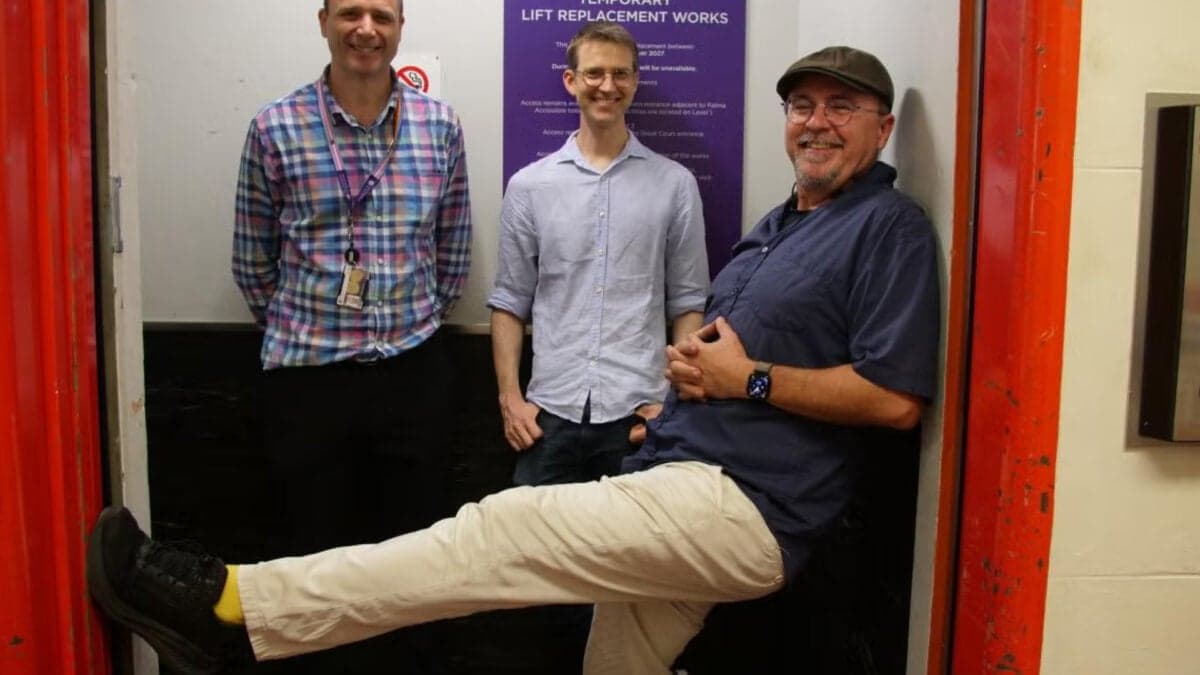
How the Message Traveled Through Brick
Physicist Matthew Davis and his team repurposed a creaky 1950s elevator on their campus. They yanked a 1.9-ton counterweight up and down to represent zeros and ones, coding the word "Gravity." Next door, in what used to be a bathroom, a gravimeter picked up the faint changes in gravitational acceleration. The message crept across at only 1 bit per minute—it took a full hour—but no brick, concrete, or steel could muffle the signal.
The scheme leans on Newton’s law of gravitation: nothing known to science can shield or weaken a gravitational field. That makes it the only communication channel that is, in principle, impossible to block.
Why Gravity Could Outperform Today’s Wireless Signals
Every wireless call, text, or video feed relies on electromagnetic waves. Those waves bounce, scatter, and die the moment they hit a thick wall, a subway tunnel, or a shielded bunker. The Queensland team’s gravitational trick sidesteps the problem entirely.
A single bit per minute is far too slow for a phone call, let alone a TikTok. The researchers, however, ran the math for better gravity sensors. Swap the gravimeter for a quantum sensor, they say, and speeds could jump to 15 bits per minute—fast enough for a slow Morse-code SOS—at distances up to 500 meters. They compare the journey to the first telegraph, which started as dots and dashes and ended as smartphones.
What Comes Next for Unblockable Messaging
The team concedes their elevator-and-counterweight rig is a prototype, not a product. Co-author Andrew White puts it bluntly: the speed and range depend on how fast you can move how much mass, and how well your sensor can detect tiny gravitational ripples.
Still, the proof is in the published paper. Other labs can now try larger masses, sharper sensors, or even suspended weights that swing like pendulums. Each tweak could shrink the hour-long wait for the word "Gravity" into something closer to real time.
What this means
Lazyfounder analysis — our interpretation, not reported fact.
Gravity-based messaging will not replace Wi-Fi or fiber, but it could create niche channels that governments or miners cannot jam or intercept—think emergency tunnels, deep mines, or submarines.
Key takeaways
- Gravity transmits information in a way no known material can block, while electromagnetic signals fail behind walls, tunnels, or Faraday cages.
- Today’s setup delivers a mere 1 bit per minute, yet projected improvements with quantum sensors could reach 15 bits per minute at 500 meters—still slow, but fast enough for low-rate alerts.
- Telecom and sensor startups have a ready-to-test blueprint: no new physics required, just existing Newtonian mechanics and off-the-shelf gravimeters.
- The experiment used a 1950s elevator and a repurposed bathroom detector, proving the method can start small and scale with better hardware.
Related on Lazyfounder
Sources
- Gizmodo · 2026-11-19
Physicists Just Sent an Unblockable Message Encoded in Gravity—Using a 1950s Elevator
This story is an original summary drafted with AI by Lazyfounder from the reporting listed above and checked by automated validation. Facts are attributed to their original publishers; sections marked as analysis are Lazyfounder's. Where a source is in another language, facts were machine-translated and quotations are reported, not reproduced. Read the original coverage via the links, and see our AI policy and corrections policy.

About the author
Editor, Lazyfounder
Tarun Mottlia edits LazyFounders, covering Indian startups, funding rounds, AI and product launches. Every story on the site is AI-assisted and checked against its cited sources before publication.
More stories by Tarun MottliaGet the LazyFounder Brief
Startup, funding and AI news in a five-minute read. Join the early-access list.
