

N Chandrasekaran’s leadership approach: How he transformed TCS and Tata Group
N Chandrasekaran, chairman of Tata Sons, is credited with reshaping Tata Consultancy Services (TCS) into a profit leader in India’s IT sector and consolidating the Tata Group’s operations during a period of transition. His leadership style and strategic focus have influenced both entities, particularly in revenue growth, debt management, and expansion into new technology-driven businesses.

Editor, Lazyfounder
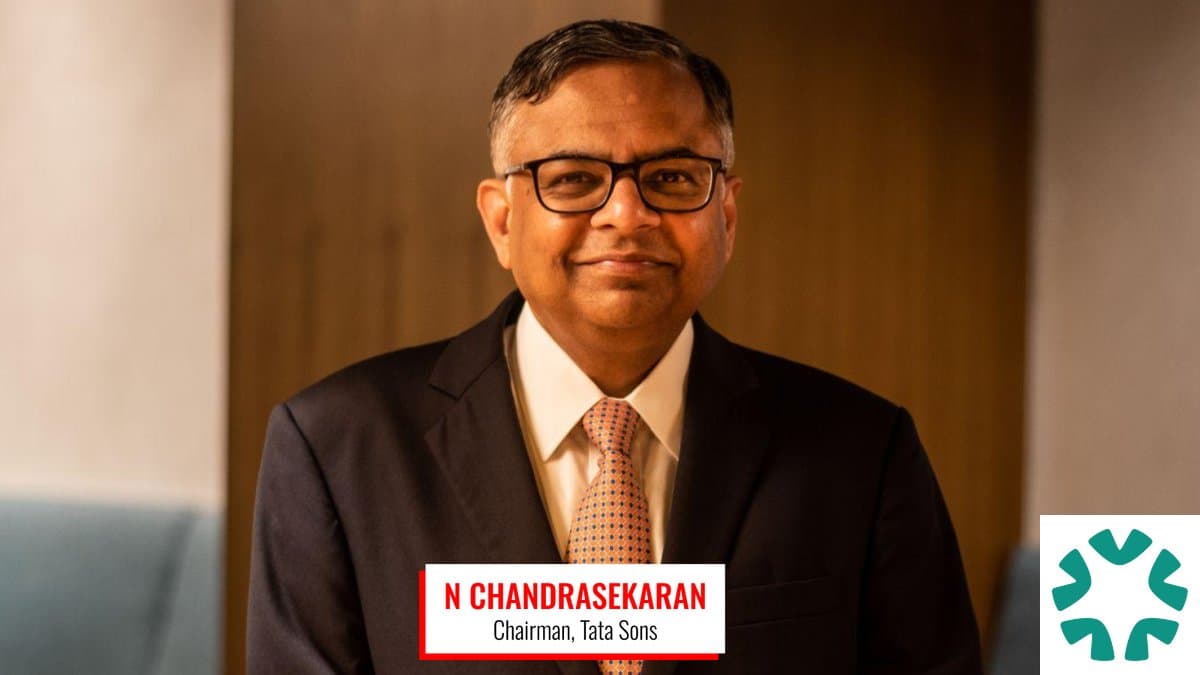
TABLE OF CONTENTS
From TCS employee to CEO: A drive for execution
According to YourStory, N Chandrasekaran joined Tata Consultancy Services (TCS) in 1987 and rose through the ranks to become CEO in 2017. A former colleague recalled an incident in New York where, even after a long day of client pitches, Chandrasekaran remained focused on improving the next day’s sales strategy. His enthusiasm for execution was evident early in his career, long before he took on leadership roles.
TCS’s profit growth under Chandrasekaran
Chandrasekaran’s leadership at TCS marked a shift in the company’s financial performance. While TCS had always been the largest Indian IT services company by revenue, its net profit lagged behind competitor Infosys before his tenure. Under his leadership, TCS not only widened its revenue lead but also surpassed Infosys in profitability, establishing itself as a bellwether for the Indian tech industry.
Tata Group’s consolidation and debt reduction
Chandrasekaran became chairman of Tata Sons in 2017, a period of internal turbulence following the ouster of Cyrus Mistry. His approach focused on consolidating the group’s businesses and reducing debt at individual companies like Tata Steel and Tata Motors. Unlike the acquisition-driven strategy of his predecessor, Ratan Tata, Chandrasekaran prioritized sustainable growth and operational efficiency.
Expansion into technology and manufacturing
Under Chandrasekaran’s leadership, the Tata Group expanded into new technology-driven sectors, including semiconductors, aerospace, electronics manufacturing, and battery production. A key initiative during his tenure was the creation of Tata Digital, which reflected his emphasis on digital transformation. The group also partnered with Apple to manufacture iPhones in Karnataka and Tamil Nadu, signaling a push into high-value manufacturing.
However, not all ventures were seamless. The acquisition of Air India presented challenges, including managing the airline’s debt and addressing consumer concerns about service quality.
Balancing vision and execution at scale
Chandrasekaran’s transition from leading a single company (TCS) to overseeing a conglomerate required a broader strategic vision while maintaining execution rigor. According to YourStory, his ability to navigate this shift has been a defining aspect of his leadership, particularly in aligning diverse businesses under a unified growth strategy.
What this means
Lazyfounder analysis — our interpretation, not reported fact.
Chandrasekaran’s leadership offers a case study for founders and operators on scaling a business within a larger conglomerate while balancing growth with financial discipline. His focus on profitability at TCS and debt reduction at Tata Group highlights the importance of operational efficiency, even in mature industries. For Indian founders, his push into semiconductors, electronics manufacturing, and digital ventures signals the Tata Group’s recognition of high-growth sectors—areas where startups might explore partnerships or competition. The challenges with Air India also serve as a reminder that large-scale turnarounds require sustained investment beyond the initial acquisition.
Sources
This story is an original summary drafted with AI by Lazyfounder from the reporting listed above and checked by automated validation. Facts are attributed to their original publishers; sections marked as analysis are Lazyfounder's. Where a source is in another language, facts were machine-translated and quotations are reported, not reproduced. Read the original coverage via the links, and see our AI policy and corrections policy.

About the author
Editor, Lazyfounder
Tarun Mottlia edits LazyFounders, covering Indian startups, funding rounds, AI and product launches. Every story on the site is AI-assisted and checked against its cited sources before publication.
More stories by Tarun MottliaGet the LazyFounder Brief
Startup, funding and AI news in a five-minute read. Join the early-access list.
