
How a Mumbai land broker built a ₹44 lakh strawberry farm without soil
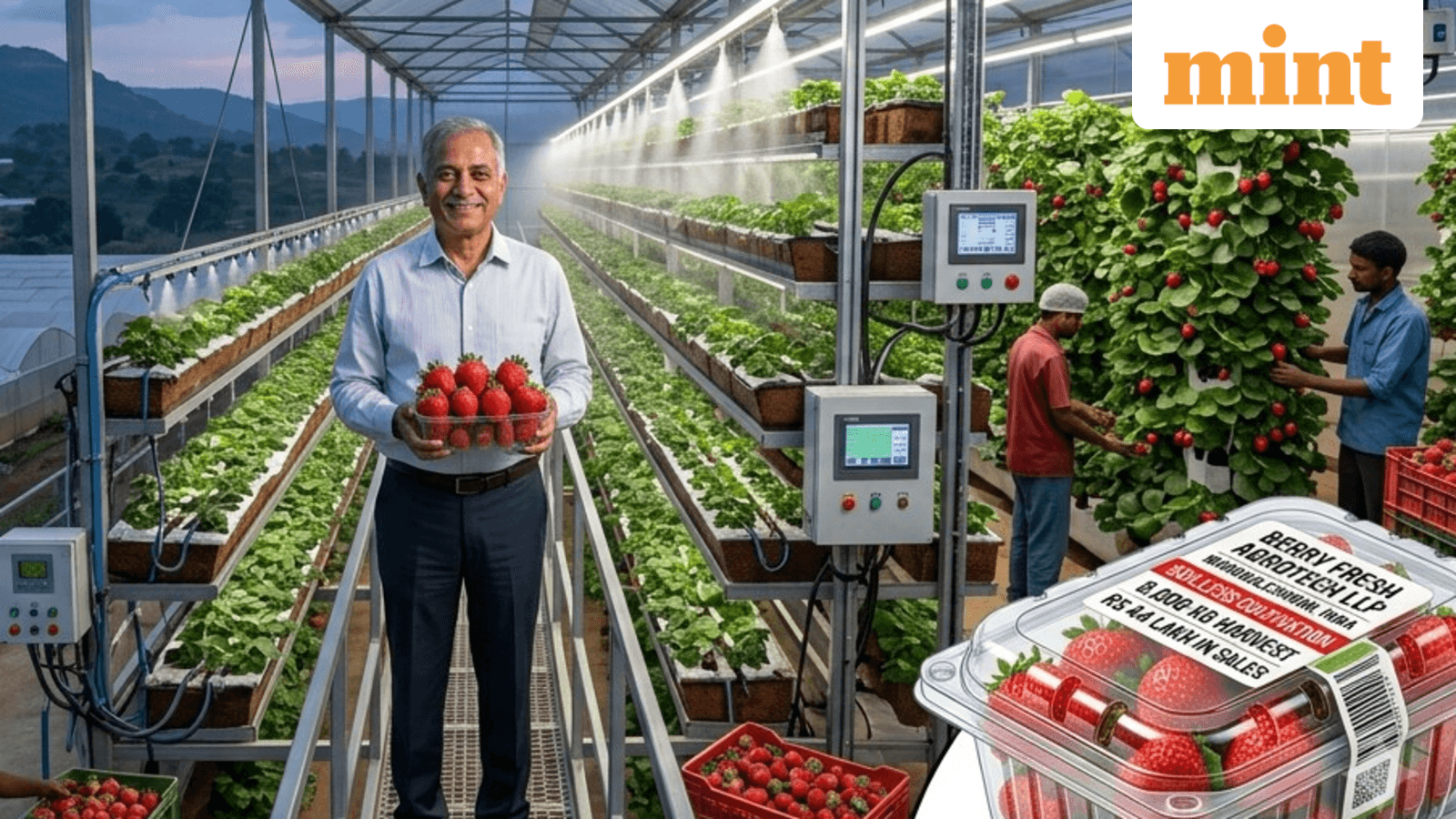
A Mumbai entrepreneur with no farming background has built a ₹44 lakh strawberry business in Mahabaleshwar—using nothing but cocopeat, automated nutrients, and a climate-controlled polyhouse. Ketan Sodha’s Berry Fresh Agrotech grows 19,500 plants without soil, pushing harvests beyond the traditional November-to-March season and yielding 8,000 kg of strawberries annually.

Editor, Lazyfounder
30 SEC SUMMARY
- Ketan Sodha, a Mumbai entrepreneur with no farming experience, turned a leased plot in Mahabaleshwar into a ₹44 lakh strawberry business using soilless farming.
- His farm produces 8,000 kg of strawberries annually from 19,500 plants, defying traditional growing seasons.
- Sodha’s model combines cocopeat, automated nutrient systems, and climate-controlled polyhouses to cut soil-borne diseases and extend harvests.
- He is testing 19 global strawberry varieties to identify the best performers for India’s climate.
- Investor discussions are underway for a new five-acre facility that could house 200,000 plants.
TABLE OF CONTENTS
From land deals to strawberries: An unlikely farmer’s pivot
Ketan Sodha never farmed before. The 57-year-old Mumbai entrepreneur spent decades brokering land deals across Maharashtra—until demonetisation in 2016 derailed his business. Instead of rebuilding his old trade, he leased a two-acre plot in Mahabaleshwar and began experimenting with strawberries. It took nearly ten years of trial and error, but by 2022, he had incorporated Berry Fresh Agrotech LLP. Today, the farm produces 8,000 kg of strawberries a year and brings in ₹44 lakh in sales.
How cocopeat and climate control redefine strawberry farming
Mahabaleshwar’s cool, high-altitude air—1,400 metres above sea level—has long made it a hub for strawberry farming. But Sodha’s farm breaks the rules. His 1,500-square-metre polyhouse ditches soil entirely, using cocopeat, a growing medium made from coconut husks. A retractable roof and misting system regulate temperature and humidity, while an automated fertigation system delivers 75 ml of nutrient solution to each plant every day. Rainwater is collected, stored, and treated with ozone before use. The setup keeps soil-borne diseases at bay and lets Sodha grow strawberries outside the usual November-to-March season.
₹44 lakh in sales and plans to scale
Each of Sodha’s 19,500 plants yields an average of 408 grams of strawberries, totalling 3.2 kg per square metre. He sells the fruit for ₹400 to ₹600 per kg, with customers spanning Mumbai, Delhi, Ahmedabad, and smaller cities like Udupi and Goa. About 60% of sales come from direct consumers, while the rest go to businesses. Unlike most agri-businesses, Berry Fresh Agrotech skips digital marketing. Instead, word-of-mouth recommendations drive growth.
Sodha is now in talks with investors to expand. His next project—a five-acre facility—could house 200,000 plants, ten times his current capacity.
Global strawberries, local results: Testing 19 varieties for India
Sodha isn’t just growing strawberries; he’s testing 19 varieties from the US, Spain, Italy, Uruguay, Japan, and the Netherlands. His goal: identify which strains deliver the highest yields, best taste, and strongest disease resistance in India’s climate. If successful, he could secure exclusive rights to certain genetics, giving Berry Fresh Agrotech a competitive edge. The long-term plan involves adapting this model to other high-altitude regions like Udupi or parts of Goa, where similar growing conditions exist.
What this means
Lazyfounder analysis — our interpretation, not reported fact.
Sodha’s farm proves that controlled-environment agriculture can slash weather-related crop losses—typically 15-20% in traditional farming—while delivering investor-friendly margins in high-value crops like strawberries. His low-cost, rainwater-dependent model also shows agri-tech doesn’t always demand heavy upfront spending or digital marketing to scale.
Key takeaways
- Soilless farming cuts soil-borne diseases and extends growing seasons, reducing reliance on traditional farming windows.
- Climate-controlled polyhouses can achieve yields of 3.2 kg per square metre—far above conventional methods.
- Testing multiple global strawberry varieties could secure genetic exclusivity for Indian markets.
- Agri-tech models using rainwater harvesting and word-of-mouth sales can compete without heavy digital marketing budgets.
Related on Lazyfounder
Sources
- Mint (Technology) · 2026-11-10
Who is Ketan Sodha? From failed first crop to ₹44 lakh in sales, Mumbai man's strawberry farming journey
This story is an original summary drafted with AI by Lazyfounder from the reporting listed above and checked by automated validation. Facts are attributed to their original publishers; sections marked as analysis are Lazyfounder's. Where a source is in another language, facts were machine-translated and quotations are reported, not reproduced. Read the original coverage via the links, and see our AI policy and corrections policy.

About the author
Editor, Lazyfounder
Tarun Mottlia edits LazyFounders, covering Indian startups, funding rounds, AI and product launches. Every story on the site is AI-assisted and checked against its cited sources before publication.
More stories by Tarun MottliaGet the LazyFounder Brief
Startup, funding and AI news in a five-minute read. Join the early-access list.
