
Mathematician Discovers New Eight-Faced Shape: The Genus-3 Polyhedron
Independent mathematician Ruslan Mizhaev has discovered a new geometric shape, the genus-3 polyhedron, an eight-faced structure with unique properties. The finding, detailed in a preprint on arXiv, adds to the field of combinatorial topology and could influence research in graph theory and three-dimensional geometry.

Editor, Lazyfounder
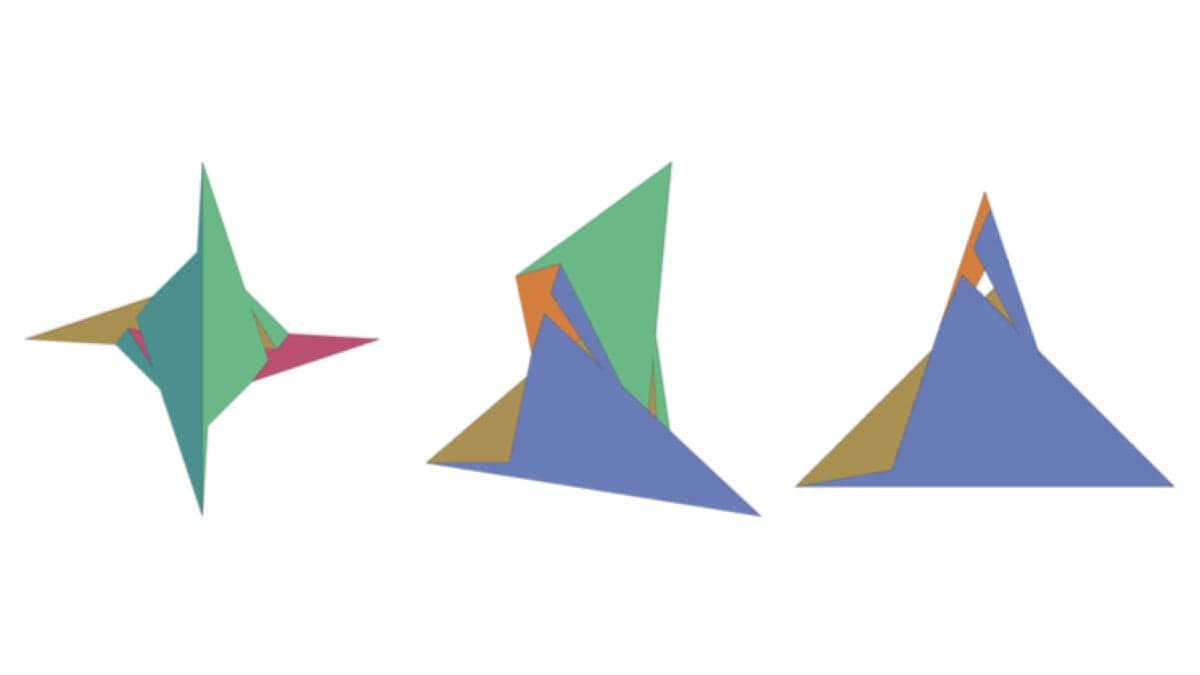
Independent mathematician Ruslan Mizhaev has discovered a new geometric shape, the genus-3 polyhedron, an eight-faced structure with unique properties. The finding, detailed in a preprint on arXiv, adds to the field of combinatorial topology and could influence research in graph theory and three-dimensional geometry.
30 SEC SUMMARY
- Independent mathematician Ruslan Mizhaev has discovered a new eight-faced shape called the genus-3 polyhedron.
- The shape has 24 vertices, 26 edges, and unique properties where every pair of faces shares at least one edge.
- The discovery is detailed in a preprint on arXiv and has not yet been peer-reviewed.
- The genus-3 polyhedron is significant in combinatorial topology, graph theory, and three-dimensional geometry.
- Related structures like the Császár and Szilassi polyhedrons are toroidal polytopes with a hole in the middle.
TABLE OF CONTENTS
- Discovery of the Genus-3 Polyhedron
- Properties and Significance
- Expert Perspective
- What this means
- Key takeaways
- FAQ
- Sources
KEY HIGHLIGHTS
- Ruslan Mizhaev discovered a new eight-faced shape called the genus-3 polyhedron.
- The shape has 24 vertices, 26 edges, and every pair of faces shares at least one edge.
- The discovery is detailed in a preprint on arXiv and has not been peer-reviewed.
- The genus-3 polyhedron is related to toroidal polytopes like the Császár and Szilassi polyhedrons.
- The achievement is recognized as significant in theoretical mathematics, particularly in combinatorial topology and graph theory.
Discovery of the Genus-3 Polyhedron
According to Gizmodo, independent mathematician Ruslan Mizhaev has identified a previously unknown eight-faced shape called the genus-3 polyhedron. The shape, described in a preprint on arXiv, features 24 vertices and 26 edges, with the distinctive property that every pair of its faces shares at least one edge.
Mizhaev’s discovery is notable for its rarity in the field of combinatorial topology. While the shape does not overturn existing mathematical conjectures, it adds a new dimension to the study of complex geometric structures.
Properties and Significance
The genus-3 polyhedron exhibits unique geometric properties. Specifically, 20 pairs of its faces share one edge, while eight pairs share two edges. This configuration makes it a rare example of a shape where no faces are entirely disconnected from one another.
The shape is part of a broader category of toroidal polytopes—polyhedrons that form a surface of revolution with a hole in the middle. The Császár and Szilassi polyhedrons are well-known examples of such structures, with the latter being the closest existing analog to the genus-3 polyhedron.
Expert Perspective
Lars Schewe, a mathematician at the University of Edinburgh, commented on the discovery, noting that constructing such shapes is a difficult and commendable task. While the genus-3 polyhedron may not challenge established theories, it represents a meaningful advancement in the study of three-dimensional geometry.
Schewe emphasized the value of such discoveries in theoretical mathematics, particularly in areas like graph theory and combinatorial topology, where unusual geometries can provide new insights.
What this means
Lazyfounder analysis — our interpretation, not reported fact.
This discovery highlights how theoretical mathematics continues to uncover fundamental structures that challenge and refine our understanding of geometry. While the genus-3 polyhedron may not revolutionize existing conjectures, its properties could inspire new research in combinatorial topology and graph theory. For founders and operators in tech—especially those working in computational geometry, simulations, or data visualization—such discoveries underscore the importance of deep mathematical research in enabling breakthroughs in applied fields.
Key takeaways
- Ruslan Mizhaev identified a new eight-faced shape, the genus-3 polyhedron, with 24 vertices and 26 edges.
- Every pair of faces in the genus-3 polyhedron shares at least one edge, a rare and significant geometric property.
- The discovery is shared in a preprint on arXiv and has not undergone peer review.
- The shape is related to toroidal polytopes like the Császár and Szilassi polyhedrons.
- Experts acknowledge the difficulty of constructing such shapes, emphasizing the achievement in theoretical mathematics.
FAQ
What is the genus-3 polyhedron?
The genus-3 polyhedron is a newly discovered eight-faced shape with 24 vertices and 26 edges. Every pair of its faces shares at least one edge, making it a rare and significant structure in combinatorial topology.
Why is this discovery important?
While the genus-3 polyhedron does not overturn existing mathematical conjectures, it provides new insights into complex geometric structures. Its properties could inspire further research in combinatorial topology, graph theory, and three-dimensional geometry.
What are toroidal polytopes?
Toroidal polytopes are polyhedrons that form a surface of revolution with a hole in the middle. Examples include the Császár and Szilassi polyhedrons, which share similarities with the genus-3 polyhedron.
Has the discovery been peer-reviewed?
No, the discovery is currently detailed in a preprint on arXiv and has not yet undergone peer review.
Related on Lazyfounder
Sources
- Gizmodo · 2026-09-29
A Mathematician Discovered a New Eight-Faced Shape. It Looks Like a Glitch in Reality
This story is an original summary drafted with AI by Lazyfounder from the reporting listed above and checked by automated validation. Facts are attributed to their original publishers; sections marked as analysis are Lazyfounder's. Where a source is in another language, facts were machine-translated and quotations are reported, not reproduced. Read the original coverage via the links, and see our AI policy and corrections policy.

About the author
Editor, Lazyfounder
Tarun Mottlia edits LazyFounders, covering Indian startups, funding rounds, AI and product launches. Every story on the site is AI-assisted and checked against its cited sources before publication.
More stories by Tarun MottliaGet the LazyFounder Brief
Startup, funding and AI news in a five-minute read. Join the early-access list.
