

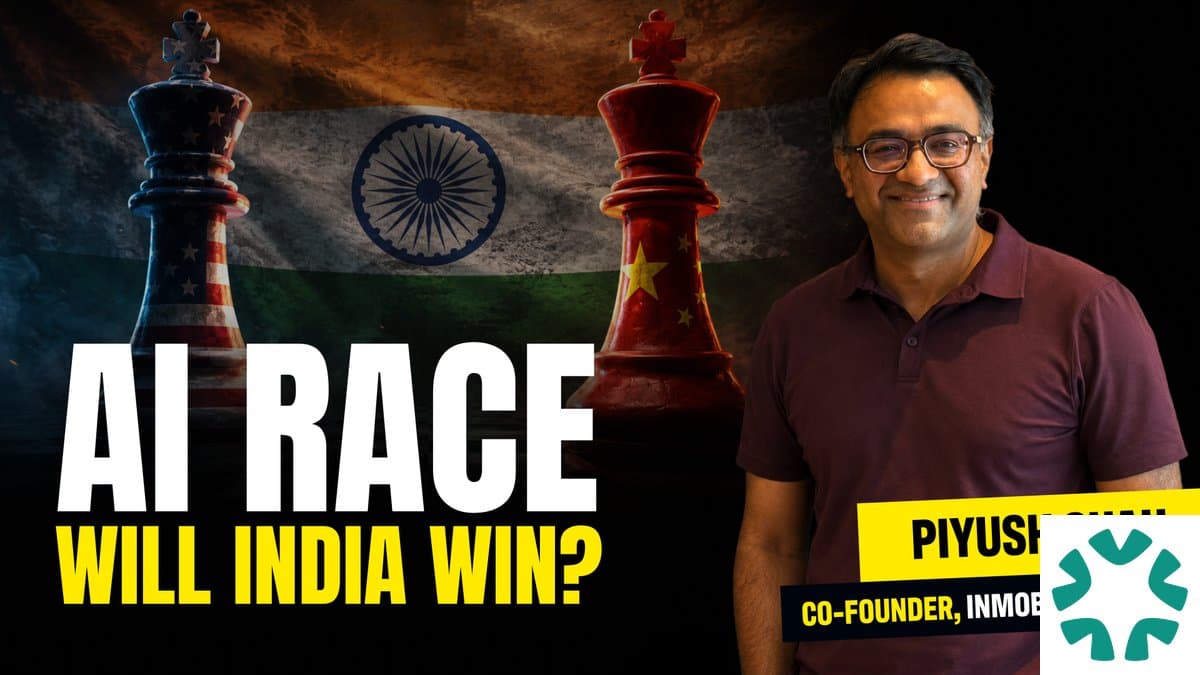
Piyush Shah: India’s AI opportunity lies in democratising technology, not frontier models
Piyush Shah, founder of two unicorns—InMobi and Glance—argues that India’s AI strategy must diverge from the paths taken by the US and China. Drawing on his experience scaling companies globally, Shah believes India’s strength lies in democratising AI for everyday use rather than competing in frontier research or industrial applications. He also highlights the economic challenges of consumer AI and the opportunities in enterprise solutions.

Editor, Lazyfounder
30 SEC SUMMARY
- Piyush Shah, founder of InMobi and Glance, argues that India’s AI strategy must differ from the US and China to leverage its unique strengths.
- Shah believes India’s opportunity lies in democratising AI for everyday use rather than focusing on frontier models or industrial AI.
- He highlights challenges in consumer AI economics, particularly the rising cost of inference tied to user engagement.
- Enterprise AI, meanwhile, is already demonstrating sustainable value, especially in domain-specific workflows.
- Distribution remains a critical moat for startups, requiring local presence, partnerships, and domain expertise.
TABLE OF CONTENTS
KEY HIGHLIGHTS
- Piyush Shah, founder of InMobi and Glance, outlines a distinct AI strategy for India, diverging from the US and China.
- The US is leading in frontier AI models and research, while China is industrialising AI in manufacturing, logistics, and robotics.
- Shah argues India’s strength lies in using AI to improve accessibility for a billion people, such as in education, healthcare, and agriculture.
- Consumer AI faces economic challenges due to rising inference costs, which scale with user engagement.
- Enterprise AI is showing clearer business value, particularly in domain-specific workflows like manufacturing, healthcare, and tax filing.
- Distribution, partnerships, and domain expertise remain critical for AI startups to scale globally.
A different AI playbook for India
According to YourStory, Piyush Shah believes the global AI ecosystem is fragmenting into distinct regional strengths. The US is leading in frontier models, research, and computing infrastructure, while China is embedding AI into manufacturing, logistics, and robotics. Shah argues that India’s opportunity lies elsewhere—using AI to solve everyday problems for millions of people rather than pursuing cutting-edge research or industrial dominance.
Shah’s perspective stems from his experience building InMobi and Glance, both of which scaled globally from India. He emphasises the importance of standing at the intersection of Silicon Valley, Bengaluru, and Beijing to identify gaps and opportunities. For India, this means focusing on AI solutions that are inclusive, scalable, and accessible, such as AI tutors, healthcare advisors, or multilingual voice interfaces.
The economics of consumer AI
Shah highlights a critical challenge in consumer AI: inference economics. Unlike traditional software, where customer acquisition cost (CAC) and lifetime value (LTV) are the primary concerns, AI companies must also account for the cost of generating each response. This "inference CAC" scales with user engagement, making it a significant expense as usage grows.
He warns that many consumer AI companies have not yet solved this problem. The cost of powering AI-based experiences can escalate quickly, potentially outweighing the revenue generated from users. Shah notes that this dynamic changes the economics of building consumer AI products, making it riskier to scale without a sustainable monetisation model.
Glance and InMobi, both of which work with consumer AI applications, are focusing on solving this challenge. Shah suggests that a new form of advertising, similar to how it enabled the open internet, may be necessary to democratise consumer AI and make it economically viable.
Enterprise AI’s clearer path to value
While consumer AI grapples with economic challenges, Shah sees enterprise AI as a space where sustainable value is already emerging. During a recent OpenAI event, he observed that enterprise transformation dominated discussions, accounting for an estimated 70% of the company’s future revenue.
Shah believes the biggest opportunities for founders lie in solving deep, domain-specific workflows. Areas like manufacturing, healthcare operations, tax filing, and pharmaceutical approvals are seeing demand for AI products that can demonstrate measurable outcomes quickly. Unlike consumer AI, enterprise solutions can justify their costs through efficiency gains and tangible business value.
Distribution as the enduring moat
Despite AI lowering the barriers to building products, Shah argues that distribution remains the most significant competitive advantage. Drawing from InMobi’s global journey, he notes that go-to-market execution—including trusted relationships, local presence, and credibility—is often underestimated by founders.
For AI startups targeting enterprises, Shah advises building thought leadership and domain expertise as alternative distribution channels. He also suggests partnering with large IT services firms like Infosys or TCS, which already possess the enterprise relationships that startups struggle to establish. This approach can accelerate adoption without requiring startups to build their own sales networks from scratch.
What this means
Lazyfounder analysis — our interpretation, not reported fact.
Shah’s arguments underscore a shift in how Indian founders should approach AI—away from chasing global benchmarks in frontier research or industrial applications and toward solving real-world problems at scale. For startups, this means prioritising accessibility, inclusivity, and sustainable economics over technological novelty. The inference cost challenge in consumer AI also signals that founders must innovate not just in product development but in monetisation models, possibly exploring new forms of advertising or usage-based pricing. Meanwhile, enterprise AI’s traction highlights the value of domain-specific solutions, where measurable outcomes can justify adoption. Finally, Shah’s emphasis on distribution as a moat is a reminder that technology alone is insufficient; startups must invest in partnerships, local presence, and credibility to compete globally.
Key takeaways
- Indian founders should prioritise AI solutions that address mass-market needs rather than chasing frontier research or industrial applications.
- The economics of consumer AI require new monetisation models to offset rising inference costs, a challenge even large players face.
- Enterprise AI presents near-term opportunities, particularly in workflows where measurable outcomes can be demonstrated quickly.
- Startups must invest in distribution, local partnerships, and domain expertise to compete globally, rather than relying solely on technology.
- Collaborating with IT services firms like Infosys or TCS can help startups accelerate adoption by leveraging existing enterprise relationships.
Sources
This story is an original summary drafted with AI by Lazyfounder from the reporting listed above and checked by automated validation. Facts are attributed to their original publishers; sections marked as analysis are Lazyfounder's. Where a source is in another language, facts were machine-translated and quotations are reported, not reproduced. Read the original coverage via the links, and see our AI policy and corrections policy.

About the author
Editor, Lazyfounder
Tarun Mottlia edits LazyFounders, covering Indian startups, funding rounds, AI and product launches. Every story on the site is AI-assisted and checked against its cited sources before publication.
More stories by Tarun MottliaGet the LazyFounder Brief
Startup, funding and AI news in a five-minute read. Join the early-access list.
