

Five Indian AI startups tackle real-world deployment challenges
Inc42 highlights five AI startups in India that are moving beyond foundation models to address bottlenecks in real-world AI deployment. These startups are building infrastructure, datasets, and applications tailored to sectors like healthcare, enterprise productivity, and content production, signaling a shift toward defensible, niche AI solutions.

Editor, Lazyfounder
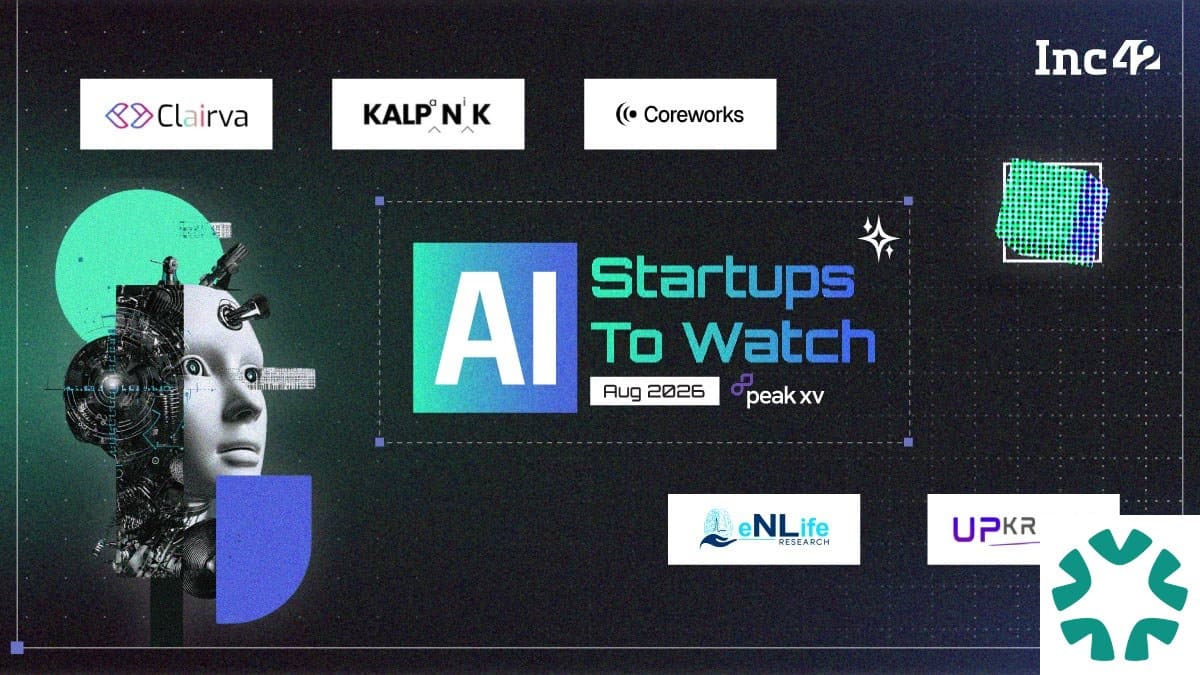
Shift from foundation models to real-world AI
According to Inc42, India’s AI startup ecosystem is moving beyond the race to build generalized foundation models like ChatGPT. Instead, startups are focusing on infrastructure, datasets, and applications that address real-world deployment challenges, particularly in sectors where Western AI companies have not prioritized local needs.
The IndiaAI Mission, a government initiative, is supporting this shift by funding indigenous sovereign AI models, building a public dataset platform, and offering subsidized GPU access to startups. The program aims to address two critical constraints: data and compute.
Startups targeting niche AI bottlenecks
The latest edition of Inc42’s "AI Startups To Watch" features five startups tackling distinct challenges in AI deployment:
Clairva is converting real-world video into structured behavioral signals for training robots and multimodal AI models. The startup focuses on markets like India, Southeast Asia, and the Global South, where AI training data is scarce. It licenses datasets to AI labs, robotics companies, and multimodal developers, having raised $500,000 in pre-seed funding led by Venture Catalysts.
Coreworks is building an enterprise productivity platform that automates report and presentation generation by connecting directly to a company’s data. The platform ensures every metric is traceable to its source, targeting India’s augmented analytics market.
eNLife Research is combining biomarker research with AI to enable early detection of neurodegenerative diseases like Alzheimer’s. Its platform aims for 95% accuracy and a 24-hour turnaround, utilizing blood-based and neuroimaging biomarkers alongside population studies.
Kalpnk operates an AI-first filmmaking studio that reduces production time for commercials and brand content by 85% and costs by 70%. The studio produces cinematic content, from reels to pitch decks, using AI workflows.
UpKraft is structuring extracurricular learning for skills like music and dance, using AI to provide real-time feedback and progress tracking. The platform serves learners, tutors, and schools, targeting the growing after-school and extracurricular program market.
Why this shift matters for founders and operators
Inc42 reports that India’s AI advantage may lie in building systems that are difficult to replicate globally—such as proprietary datasets, local-language capabilities, and domain-specific intelligence. This shift is attracting capital, with Indian AI startups raising $676 million in H1 2026, nearly four times the amount raised in the same period the previous year.
The startups highlighted are not merely integrating AI as a feature but are attempting to build businesses around complex problems that arise when AI moves from the laboratory to real-world applications. This approach could create defensibility in sectors where generic AI models fall short.
What this means
Lazyfounder analysis — our interpretation, not reported fact.
India’s AI startup ecosystem is shifting from chasing generalized foundation models to building specialized infrastructure, datasets, and applications that address gaps Western AI companies have not prioritized.
This matters to founders and operators because it signals a move toward defensibility: proprietary data, language-specific models, and domain expertise are becoming the differentiators, not just raw model size. The government’s IndiaAI Mission is subsidizing compute and curating datasets, but the startups highlighted here are going further—targeting bottlenecks like real-world AI training data, enterprise productivity, healthcare diagnostics, and content production.
For investors, the surge in funding (nearly 4x year-on-year) suggests confidence in this layer of the AI stack. For founders, the message is clear: building for India-specific problems—whether in healthcare, education, or enterprise workflows—can create an edge, especially if the solution is difficult to replicate globally. The startups profiled are not just integrating AI as a feature; they are betting on AI as the core of entirely new business models.
Key takeaways
- India’s AI startups are moving beyond foundation models to focus on specialized infrastructure, datasets, and applications tailored to local and global markets.
- Proprietary data, domain expertise, and language-specific capabilities are emerging as key differentiators over raw model size.
- Government support, such as subsidized compute and curated datasets, is lowering barriers for startups addressing real-world AI deployment challenges.
- Funding for Indian AI startups reached $676 million in H1 2026, reflecting investor confidence in niche, defensible AI applications.
- Startups are targeting bottlenecks in AI adoption, such as training data for physical-world AI, enterprise productivity, healthcare diagnostics, and content production.
Sources
- inc42.com · 2026-08-15
AI Startups To Watch: 5 Startups That Caught Our Eye In August
This story is an original summary drafted with AI by Lazyfounder from the reporting listed above and checked by automated validation. Facts are attributed to their original publishers; sections marked as analysis are Lazyfounder's. Where a source is in another language, facts were machine-translated and quotations are reported, not reproduced. Read the original coverage via the links, and see our AI policy and corrections policy.

About the author
Editor, Lazyfounder
Tarun Mottlia edits LazyFounders, covering Indian startups, funding rounds, AI and product launches. Every story on the site is AI-assisted and checked against its cited sources before publication.
More stories by Tarun MottliaGet the LazyFounder Brief
Startup, funding and AI news in a five-minute read. Join the early-access list.
