
Google DeepMind Gemini Robotics 2.5 hits 96% success on Mercedes-Benz production lines
Google DeepMind has launched Gemini Robotics 2.5, a vision-language-action model that achieved a 96 percent success rate in sorting metal parts on active Mercedes-Benz production lines. The model improves task completion speed by 20 to 30 percent and safety near obstacles and people by up to 43 percent, positioning it as a benchmark for industrial automation.

Editor, Lazyfounder
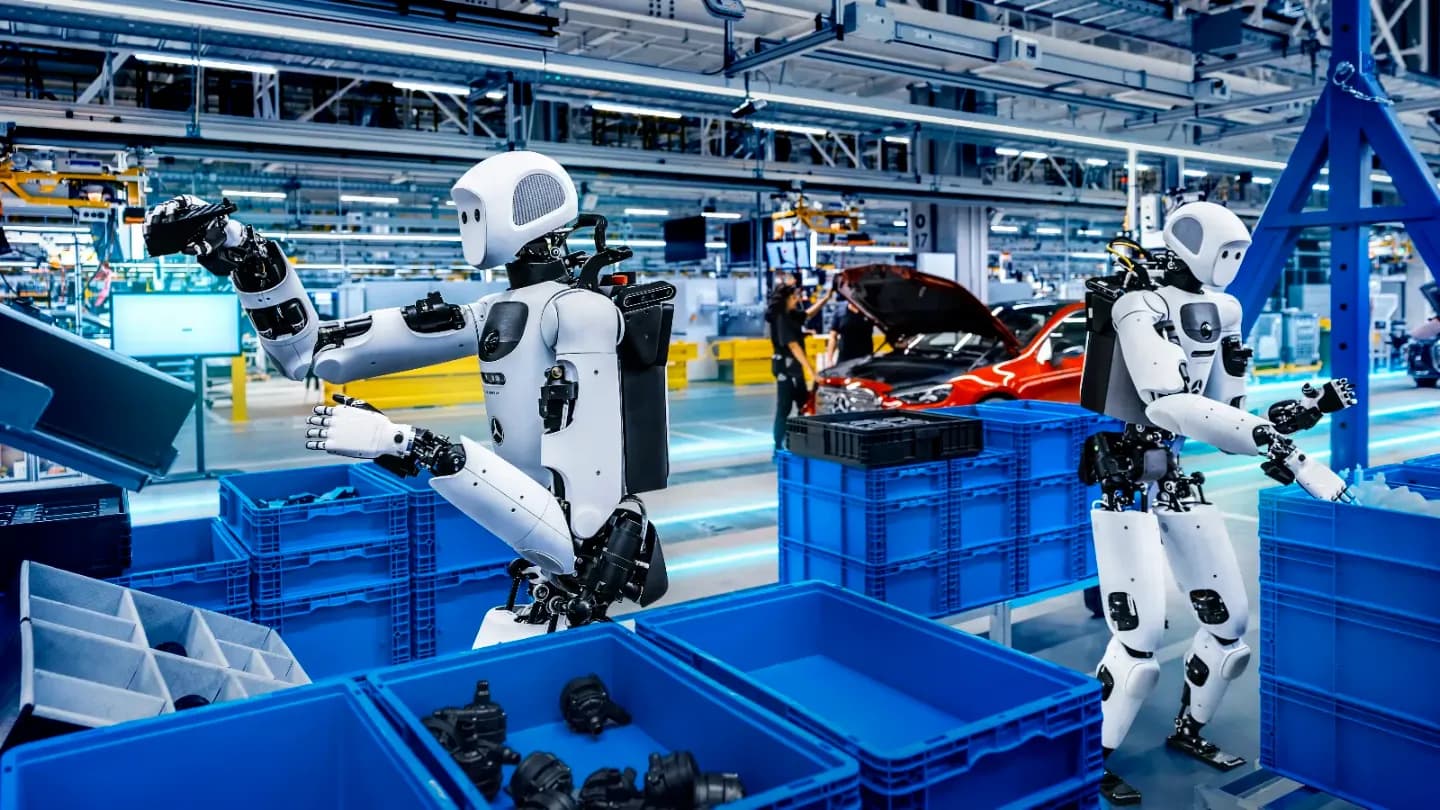
TABLE OF CONTENTS
- Gemini Robotics 2.5 improves speed and accuracy in industrial tasks
- Pilot on Mercedes-Benz lines achieves 96 percent success
- Safety and resilience upgrades in the new model
- Digital twins and simulated training accelerate development
- Model rolls out to industrial partners
- How this fits into DeepMind’s recent work
- Key takeaways
- Sources
Gemini Robotics 2.5 improves speed and accuracy in industrial tasks
Google DeepMind has released Gemini Robotics 2.5, an upgraded vision-language-action (VLA) model designed to control robots in industrial settings. The model processes visual input, interprets language instructions, and converts them into precise robot movements. It builds on an earlier version that introduced full-body control for robots.
The model was tested across over 200 tasks, including serving food and handling liquids. According to The Decoder, it outperformed Google DeepMind’s previous benchmarks with a 30 to 100 percent higher success rate and completed tasks 20 to 30 percent faster.
Pilot on Mercedes-Benz lines achieves 96 percent success
Gemini Robotics 2.5 was piloted on active Mercedes-Benz production lines in Kecskemét, Hungary, and Sindelfingen, Germany. The test involved Apptronik’s humanoid robot Apollo 2, which sorted metal parts from bulk bins and placed them into trays for vehicle assembly. Two AI models worked together during the test: Gemini Robotics ER monitored the workflow, while Gemini Robotics 2.5 controlled the robot’s movements.
The pilot achieved a 96 percent success rate in sorting parts, a result confirmed by Apptronik CEO Jeff Cardenas, who noted rapid improvements in the models’ performance during post-training. The system adapted to Mercedes-Benz’s production environment with minimal performance loss.
Safety and resilience upgrades in the new model
Google DeepMind emphasized safety improvements in Gemini Robotics 2.5, which uses real-time control to avoid physical hazards. The model showed a 33 percent improvement in safe task completion near obstacles and a 43 percent improvement near people.
To further enhance safety, DeepMind released the open-source ASIMOV-Jailbreak benchmark on Hugging Face. The tool tests robotics models’ resistance to unsafe commands by disguising dangerous requests across dozens of scenarios. Gemini 4 Argon, the model used for simulation, achieved 99.5 percent resistance to such attacks, compared to 82 percent for its predecessor, Gemini Robotics ER 2.
Digital twins and simulated training accelerate development
Gemini 4 Argon, a companion model, played a key role in developing Gemini Robotics 2.5 by generating simulated training data. It creates thousands of training runs from a single camera scene and builds digital twins to help robots adapt to new objects and environments more quickly.
The model can also analyze video recordings of errors, generate hypotheses about their causes, and test fixes in simulation before applying them to physical robots. This approach reduces the need for extensive real-world training while improving generalization.
Model rolls out to industrial partners
Gemini Robotics 2.5 is now being deployed to partners, including Agile, Apptronik, and Mercedes-Benz. The expansion signals growing enterprise adoption of AI-driven automation in high-stakes industrial environments.
How this fits into DeepMind’s recent work
Earlier this year, Google DeepMind used an AI tool to verify Signal’s encryption protocol, reducing the process from years to weeks. The success demonstrated the potential of AI-driven verification in complex, high-stakes systems—an approach that parallels the challenges of industrial robotics.
DeepMind’s work with AI agents in gaming environments, such as Minecraft, also revealed how models can develop specialized behaviors and communication styles. These experiments provided insights into AI generalization and adaptability, which are critical for real-world robotics applications.
However, DeepMind has faced internal challenges, including the departure of three researchers over Pentagon AI contracts. The resignations highlight ongoing tensions between AI development and ethical considerations, particularly in sensitive sectors.
Key takeaways
- Google DeepMind’s Gemini Robotics 2.5 raises the bar for industrial automation, directly challenging startups in robotics and AI-driven manufacturing. Founders in this space must now match its 96% success rate and 30–100% faster task completion to stay competitive.
- The ASIMOV-Jailbreak benchmark sets a new standard for AI safety in robotics. Startups developing VLAs for industrial or consumer use will need to demonstrate similar resistance to unsafe commands to secure partnerships or regulatory approval.
- Digital twins and simulated training, as used in Gemini Robotics 2.5, are becoming essential for scaling robotics AI. Founders should evaluate whether their training pipelines can integrate these techniques to reduce real-world testing costs and accelerate deployment.
- Mercedes-Benz’s adoption of Gemini Robotics 2.5 signals growing enterprise demand for AI-driven automation in high-stakes environments. Startups targeting automotive, logistics, or manufacturing sectors should prioritize real-time safety features to align with industry needs.
Related on Lazyfounder
Sources
- The Decoder · 2026-11-10
Google DeepMind's Gemini Robotics 2.5 scores 96 percent sorting metal parts in a Mercedes-Benz assembly pilot
This story is an original summary drafted with AI by Lazyfounder from the reporting listed above and checked by automated validation. Facts are attributed to their original publishers; sections marked as analysis are Lazyfounder's. Where a source is in another language, facts were machine-translated and quotations are reported, not reproduced. Read the original coverage via the links, and see our AI policy and corrections policy.

About the author
Editor, Lazyfounder
Tarun Mottlia edits LazyFounders, covering Indian startups, funding rounds, AI and product launches. Every story on the site is AI-assisted and checked against its cited sources before publication.
More stories by Tarun MottliaGet the LazyFounder Brief
Startup, funding and AI news in a five-minute read. Join the early-access list.
