

Former Google DeepMind researcher founds Dyssonance to build AI that resolves contradictions
Dr. Jennifer Prendki, a former Google DeepMind researcher, has launched Dyssonance, a startup focused on rethinking artificial intelligence from the ground up. The company is developing a common-sense reasoning engine designed to handle ambiguity, resolve contradictions, and refine its understanding of information over time—rather than relying on memorization or pattern recognition.

Editor, Lazyfounder
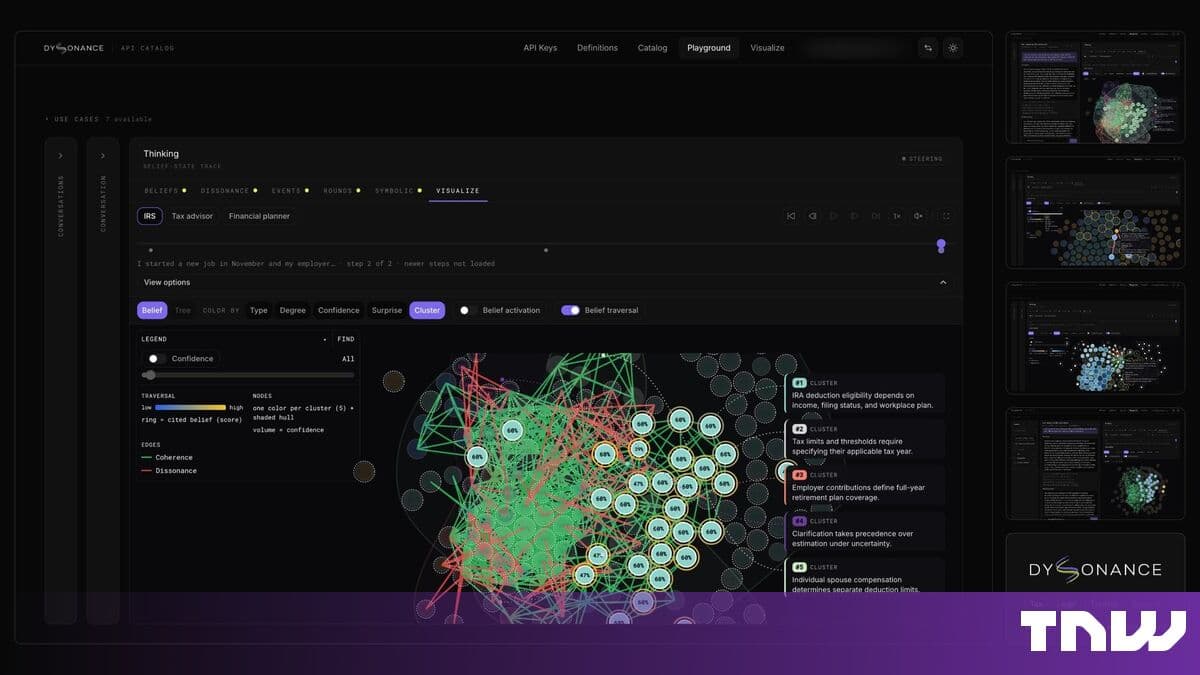
Dyssonance builds an AI reasoning engine, not another LLM
Dr. Jennifer Prendki, a former researcher at Google DeepMind, has founded Dyssonance, a startup aimed at redefining how artificial intelligence processes information. The company focuses on enabling AI to handle ambiguity, resolve contradictions, and develop a deeper understanding of facts rather than merely memorizing them.
From DeepMind to Dyssonance: Why Prendki left and what the startup aims to change
Prendki left Google DeepMind after growing uncomfortable with the direction of AI development, particularly the focus on scaling models without addressing fundamental limitations. She described feeling unable to meaningfully influence decisions about the data used to train systems like Gemini, which kept her awake at night. Her departure reflects broader tensions within the field—three other DeepMind researchers recently resigned over Pentagon AI contracts.
She founded Dyssonance to pursue a different approach: building a common-sense reasoning engine that continuously refines its understanding of information. Unlike large language models (LLMs) that rely on pattern recognition and memorization, Dyssonance’s system aims to recognize contradictions, adjust interpretations as new evidence emerges, and actively resolve dissonances rather than ignoring them.
Prendki’s vision aligns with concerns she observed at DeepMind, where she felt too few researchers questioned the long-term consequences of AI deployment. Dyssonance’s manifesto critiques the industry’s reliance on "bigger models, faster answers, or more powerful memory," arguing that true intelligence requires systems to "question, learn, adapt, and make better sense of the world."
How Dyssonance’s approach diverges from Google’s AI strategy
Earlier Lazyfounder reporting showed Google’s current trajectory: AI agents in Google Cloud now run autonomously with voice capabilities, and DeepMind’s tools recently verified Signal’s encryption protocol in four weeks. Dyssonance, however, is betting on a different path—one where AI develops evolving interpretations of information rather than static outputs.
This contrast underscores a growing divide in AI development. While Google and others pursue scalable, product-ready models, Dyssonance is prioritizing foundational reasoning capabilities. If successful, its approach could offer a modular layer for AI systems, making them more adaptable and easier to audit than monolithic models.
The startup’s emphasis on resolving contradictions also aligns with recent research showing AI agents in simulated environments developing their own languages and bureaucratic structures. Dyssonance aims to formalize that capacity, turning it into a reusable engine for real-world applications.
What this means
Lazyfounder analysis — our interpretation, not reported fact.
Dyssonance stakes out the opposite side of the same philosophical divide that recently led three Google DeepMind researchers to quit over Pentagon contracts. While DeepMind continues to scale models and integrate them into products like Gemini Live and Fitbit Edge, Prendki’s startup is betting that real progress will come from reasoning engines that actively question and resolve contradictions. For founders building AI-powered products, Dyssonance’s approach—if successful—could offer a modular common-sense layer that sits beneath domain-specific agents, making them more adaptable and easier to audit than today’s monolithic models.
Key takeaways
- Dyssonance is building a common-sense reasoning engine, not another large language model, to address ambiguity and contradictions in AI.
- Prendki’s departure from Google DeepMind follows a pattern of internal tension over the direction of AI development, similar to recent resignations over Pentagon contracts.
- The startup’s focus on understanding over memorization could provide a foundation for more adaptable and auditable AI systems.
- Founders and operators should watch whether Dyssonance’s modular approach gains traction as a complement—or alternative—to large-scale models like Gemini.
Related on Lazyfounder
- Google DeepMind
- More ai news
- Google Cloud’s AI agents now work autonomously with voice and guardrails
- Google DeepMind’s AI audits Signal encryption in four weeks
- AI agents in Minecraft experiments form bureaucracies and develop own languages
- Google DeepMind loses three researchers over Pentagon AI deals
Sources
- The Next Web · 2026-11-16
The paradox of AI safety
This story is an original summary drafted with AI by Lazyfounder from the reporting listed above and checked by automated validation. Facts are attributed to their original publishers; sections marked as analysis are Lazyfounder's. Where a source is in another language, facts were machine-translated and quotations are reported, not reproduced. Read the original coverage via the links, and see our AI policy and corrections policy.

About the author
Editor, Lazyfounder
Tarun Mottlia edits LazyFounders, covering Indian startups, funding rounds, AI and product launches. Every story on the site is AI-assisted and checked against its cited sources before publication.
More stories by Tarun MottliaGet the LazyFounder Brief
Startup, funding and AI news in a five-minute read. Join the early-access list.
