
Envision launches 800V DC power system at Inner Mongolia AI data center
Chinese energy and technology company Envision has deployed an 800-volt direct-current power system at its Galaxy AI data center in Inner Mongolia, claiming it as the first commercial installation of its kind. The design eliminates traditional AC conversion steps, integrates battery storage, and targets renewable energy integration to improve efficiency and reduce physical footprint.

Editor, Lazyfounder
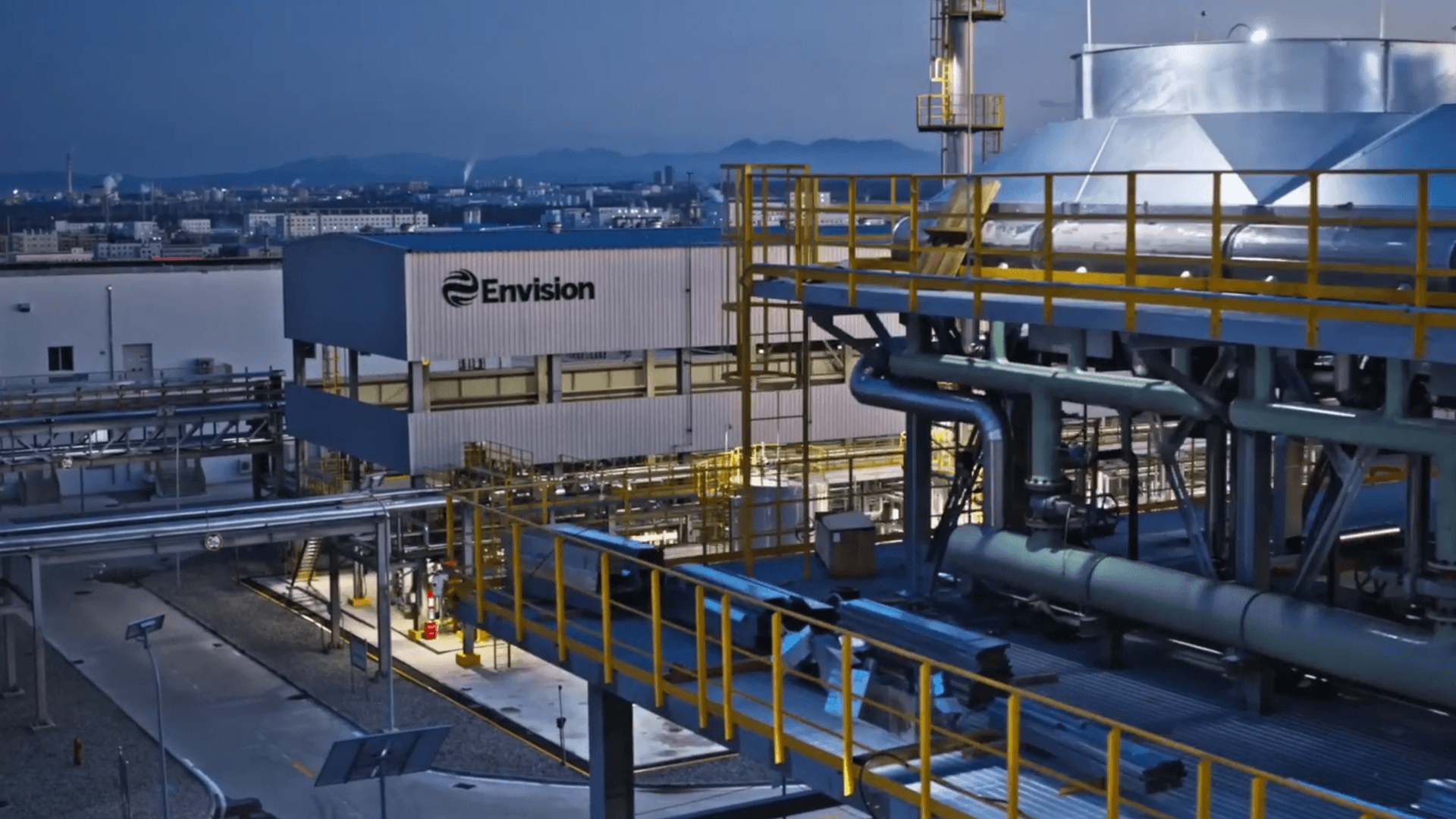
TABLE OF CONTENTS
First commercial 800V DC power system for AI data centers
Chinese energy and technology company Envision has activated what it calls the first commercial 800-volt direct-current (DC) power system for AI data centers, at its Galaxy AI campus in Ulanqab, Inner Mongolia.
How the architecture improves efficiency
The system skips the usual AC distribution stages by converting 10-kilovolt grid power directly into 800V DC, reducing both conversion losses and the physical space required for power equipment. Higher-voltage DC also cuts copper usage, lowering material costs as data centers scale.
Battery storage and demand response
A central Dubhe controller and integrated battery storage respond within milliseconds to sudden spikes in GPU power demand, a common challenge in AI training workloads. The batteries can also provide several minutes of backup power during grid interruptions.
Scaling and renewable integration
Envision says the Galaxy AI facility will reach 3 gigawatts, enough to power roughly one million AI accelerators. The company is also rolling out the technology through Mission Gobi, a plan to build 5 gigawatts of renewable-powered computing capacity across desert sites by 2030.
Unverified claims and operator caution
While the deployment marks a commercial milestone for Envision, the company has not released independently verified data on efficiency gains, installation costs, or savings. TechRadar reports that performance under sustained full-load conditions and across diverse hardware setups remains unproven.
What this means
Lazyfounder analysis — our interpretation, not reported fact.
Envision’s 800V DC power system challenges the traditional data-center power architecture that startups and cloud providers have relied on. Conventional AC distribution stacks multiple conversion stages, each adding cost, heat, and space—critical constraints when deploying thousands of GPUs. By cutting those steps and pairing the system with battery storage, Envision reduces both capex (fewer transformers, less copper) and opex (lower electricity losses). For founders planning AI infrastructure, this architecture is a live proof-point that renewables-plus-storage can be integrated natively, not bolted on later. The catch: independent efficiency or cost data is still missing, so operators will need to run their own trials before adopting it at scale.
Key takeaways
- Envision’s 800V DC system eliminates intermediate AC conversion steps, cutting equipment footprint and electricity losses in AI data centers.
- Battery storage is embedded in the architecture, allowing millisecond response to GPU demand spikes and minutes of backup power.
- The Galaxy AI campus in Inner Mongolia aims to scale to 3 GW, enough for about one million AI accelerators, signaling commercial ambition.
- Mission Gobi targets 5 GW of renewable-powered computing capacity by 2030, positioning the technology as a tool for both efficiency and sustainability.
- No independent efficiency or cost benchmarks have been released; operators considering adoption will need on-site validation.
Related on Lazyfounder
Sources
- TechRadar · 2026-11-09
Has China cracked the AI data center power problem? New 800-volt DC power system is a 'world first,' offering greater efficiency and conversion than ever
This story is an original summary drafted with AI by Lazyfounder from the reporting listed above and checked by automated validation. Facts are attributed to their original publishers; sections marked as analysis are Lazyfounder's. Where a source is in another language, facts were machine-translated and quotations are reported, not reproduced. Read the original coverage via the links, and see our AI policy and corrections policy.

About the author
Editor, Lazyfounder
Tarun Mottlia edits LazyFounders, covering Indian startups, funding rounds, AI and product launches. Every story on the site is AI-assisted and checked against its cited sources before publication.
More stories by Tarun MottliaGet the LazyFounder Brief
Startup, funding and AI news in a five-minute read. Join the early-access list.
