

Bihar non-profit grew from conversations, not funding or roadmaps
MurariJyoti Welfare Foundation (MJWF), a Bihar-based non-profit, reached around 3,500 people by starting with informal conversations about health needs rather than a structured project or external funding. The organisation’s work expanded organically as the community identified its own priorities, from menstrual health to chronic disease screenings.

Editor, Lazyfounder
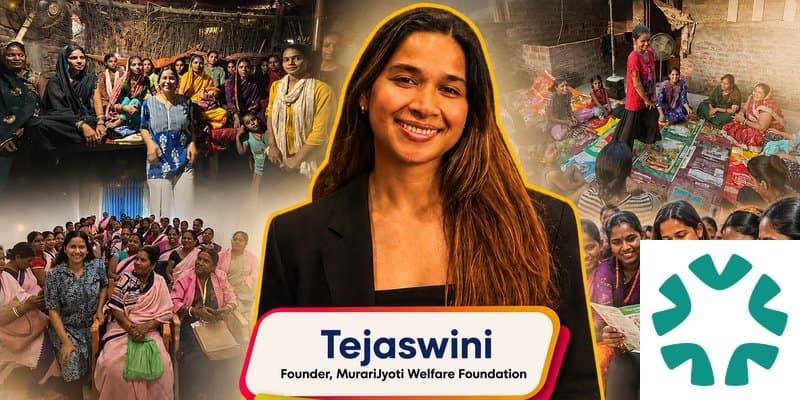
TABLE OF CONTENTS
How the work began
MurariJyoti Welfare Foundation (MJWF) started not with a project or funding but with conversations between founder Tejaswini and women in Bihar about menstruation and health. These discussions, initially informal, included input from ASHA workers and revealed gaps in awareness and access to basic health information, according to YourStory.
From menstrual cups to chronic disease screening
The organisation distributed over 500 menstrual cups after initial talks, but its work expanded as the community identified broader health issues. ASHA workers highlighted the need for school-based conversations with girls and boys about menstruation. Later, reports of diabetes, hypertension, and cervical cancer led MJWF to organise non-communicable disease (NCD) health camps, offering free screenings and information on government health services, as reported by YourStory.
Tejaswini told YourStory that the expansion was not part of a predetermined plan. Instead, each new intervention was a response to a need voiced by the community, such as unawareness about free medicines in government hospitals.
Trust as the foundation
The biggest challenge in rural outreach was not lack of resources but building trust, according to YourStory. Initial resistance faded only after the team repeatedly returned to the community over several months. Tejaswini described this shift as a "crucial milestone": when the community began asking about its next need rather than waiting for outsiders to propose solutions.
Beyond health: education and entrepreneurship
MJWF is now exploring opportunities in education, employment, and entrepreneurship for women. However, Tejaswini emphasised to YourStory that the organisation avoids imposing fixed models. Instead, it follows a process of listening, researching, and then developing solutions tailored to the community’s specific problems.
Partners and recognition
MJWF’s partners include the University of Essex, UK health innovation company 10zyme, Bhagalpur Medical College, and the Bihpur Primary Health Centre. In 2026, the organisation received Goonj’s Grassroots Award, as reported by YourStory.
What this means
Lazyfounder analysis — our interpretation, not reported fact.
MJWF’s journey offers a practical lesson for founders and operators, especially those working in social impact or community-driven models: starting small and listening deeply can reveal unmet needs that scaled, top-down approaches often miss.
For founders, the takeaway is not about avoiding plans altogether but about leaving room for iteration based on real feedback. Tejaswini’s approach—funding the initial work herself, testing assumptions through direct conversations, and expanding only when the community signalled a need—mirrors the lean startup principle of validating demand before scaling. This is particularly relevant for startups in health, education, or rural markets, where assumptions about user needs are often flawed.
For operators, MJWF’s experience underscores the importance of trust as a prerequisite for impact. In rural or underserved contexts, credibility isn’t built through rapid rollouts but through consistent presence and patience. The organisation’s shift from menstrual health to chronic disease screenings—driven by community feedback—shows how flexibility in execution can uncover adjacencies that fixed plans would overlook.
Finally, the story highlights a counterintuitive measure of success: obsolescence. For MJWF, the goal isn’t growth for its own sake but enabling the community to eventually operate independently. This challenges conventional startup metrics (scale, funding) and asks founders to define success beyond their own organisation’s survival.
Key takeaways
- MJWF’s work began with conversations, not funding or a grand plan, demonstrating how direct engagement with a community can uncover unmet needs that structured programs might miss.
- The organisation’s expansion—from menstrual health to chronic disease screenings—was driven by community feedback, not a fixed roadmap, showing how iterative listening can reveal adjacencies in social impact work.
- Trust, not resources, was the biggest challenge in rural outreach; consistent presence over months was required to build credibility, a lesson for any founder or operator working in underserved markets.
- MJWF’s goal is to make itself obsolete by enabling the community to identify and address its own needs, redefining success for social organisations beyond traditional metrics like reach or funding.
Sources
This story is an original summary drafted with AI by Lazyfounder from the reporting listed above and checked by automated validation. Facts are attributed to their original publishers; sections marked as analysis are Lazyfounder's. Where a source is in another language, facts were machine-translated and quotations are reported, not reproduced. Read the original coverage via the links, and see our AI policy and corrections policy.

About the author
Editor, Lazyfounder
Tarun Mottlia edits LazyFounders, covering Indian startups, funding rounds, AI and product launches. Every story on the site is AI-assisted and checked against its cited sources before publication.
More stories by Tarun MottliaGet the LazyFounder Brief
Startup, funding and AI news in a five-minute read. Join the early-access list.
