

Nykaa’s inventory-led model drives 21.7% YoY rise in traded goods spend
Nykaa’s inventory-led model, where it owns and sells stock directly, drove a 21.7% year-over-year increase in spending on traded goods to ₹1,757.9 Cr in Q1 FY27, according to Inc42. The approach eliminates reliance on marketplace fees and supports its expansion into physical stores and quick commerce.

Editor, Lazyfounder
KEY HIGHLIGHTS
- Nykaa operates an inventory-led model, buying stock outright from brands and selling it on its own account rather than acting as a marketplace.
- In Q1 FY27, Nykaa spent ₹1,757.9 Cr on purchasing traded goods, a 21.7% YoY increase.
- The model eliminates reliance on seller commissions, listing fees, or platform charges commonly used by food delivery and quick commerce apps.
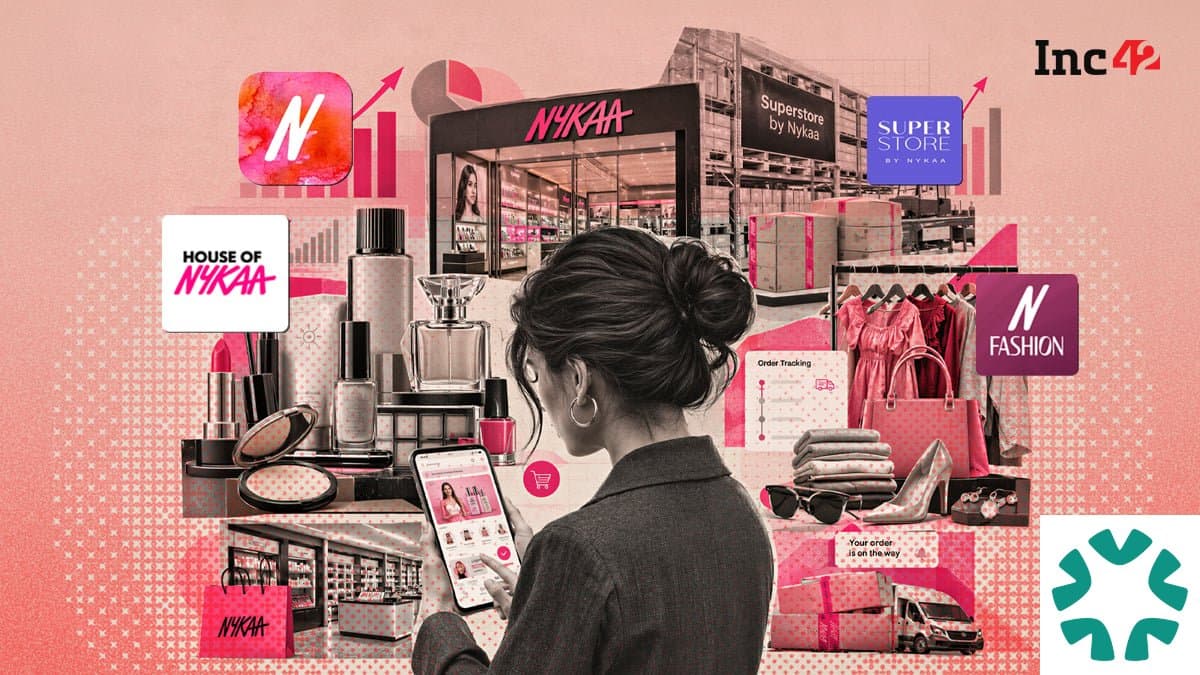
- Nykaa’s decision to own inventory supports its physical stores, fashion marketplace, owned brands, and ten-minute delivery services.
Nykaa’s Inventory Model Explained
According to Inc42, Nykaa’s business model is built on an inventory-led approach, where it purchases stock directly from brands, stores it in its own warehouses, and sells it under its own account. This differs from marketplace models, where platforms facilitate transactions between third-party sellers and buyers without owning the inventory.
The report notes that Nykaa’s decision to own inventory rather than operate as a marketplace eliminates reliance on traditional revenue streams like seller commissions, listing fees, or platform charges. These fees are common in sectors like food delivery and quick commerce, where platforms act as intermediaries.
Financial Commitment and Growth
Inc42 reports that Nykaa’s spending on traded goods reached ₹1,757.9 Cr in Q1 FY27, reflecting a 21.7% year-over-year increase. This expenditure highlights the capital-intensive nature of an inventory-led model, where working capital is tied up in stock ownership.
The scale of this investment supports Nykaa’s expansion across multiple verticals, including physical retail stores, a fashion marketplace, owned brands, and ten-minute delivery services. The model’s flexibility allows Nykaa to integrate these initiatives without fragmenting its supply chain.
Comparison to Marketplace Models
While Nykaa has been compared to Amazon, Inc42 clarifies that the comparison is limited. Unlike Amazon’s marketplace model, which relies on third-party sellers, Nykaa’s beauty segment operates primarily as a retailer, owning the inventory it sells. This distinction allows Nykaa to maintain tighter control over product quality, pricing, and customer experience.
The report suggests that Nykaa’s model reduces dependency on external sellers, which can be advantageous in categories like beauty, where brand authenticity and consistency are critical to customer trust.
What this means
Lazyfounder analysis — our interpretation, not reported fact.
Nykaa’s inventory-led model underscores a fundamental choice for ecommerce and D2C founders: whether to control the supply chain or rely on third-party sellers. While the marketplace model reduces capital expenditure, Nykaa’s approach prioritizes margin control, brand consistency, and operational flexibility. This model has allowed Nykaa to expand into physical retail, private labels, and rapid delivery without diluting its margins through platform fees. For founders, the trade-off is clear—higher upfront investment in inventory versus long-term control over customer experience and profitability. The challenge lies in balancing working capital needs with scalability, especially in sectors where inventory turnover and demand forecasting are critical.
Key takeaways
- Founders in inventory-heavy sectors like beauty or fashion can assess whether an inventory-led model could reduce dependency on platform fees and improve margin control.
- The inventory model requires significant working capital, as seen in Nykaa’s ₹1,757.9 Cr spend on traded goods in a single quarter, which may not be feasible for early-stage startups.
- Direct ownership of inventory allows for greater control over customer experience, branding, and logistics, which could be a competitive advantage in categories like beauty.
- Operators in D2C or ecommerce should evaluate whether Nykaa’s model—scaling physical retail, owned brands, and quick commerce under one inventory system—could inform their own expansion strategies.
Sources
- inc42.com · 2026-08-07
Inside Nykaa's Inventory Model: Where The Margin Comes From
This story is an original summary drafted with AI by Lazyfounder from the reporting listed above and checked by automated validation. Facts are attributed to their original publishers; sections marked as analysis are Lazyfounder's. Where a source is in another language, facts were machine-translated and quotations are reported, not reproduced. Read the original coverage via the links, and see our AI policy and corrections policy.

About the author
Editor, Lazyfounder
Tarun Mottlia edits LazyFounders, covering Indian startups, funding rounds, AI and product launches. Every story on the site is AI-assisted and checked against its cited sources before publication.
More stories by Tarun MottliaGet the LazyFounder Brief
Startup, funding and AI news in a five-minute read. Join the early-access list.
