
Developer ports Doom to run inside a SQL database
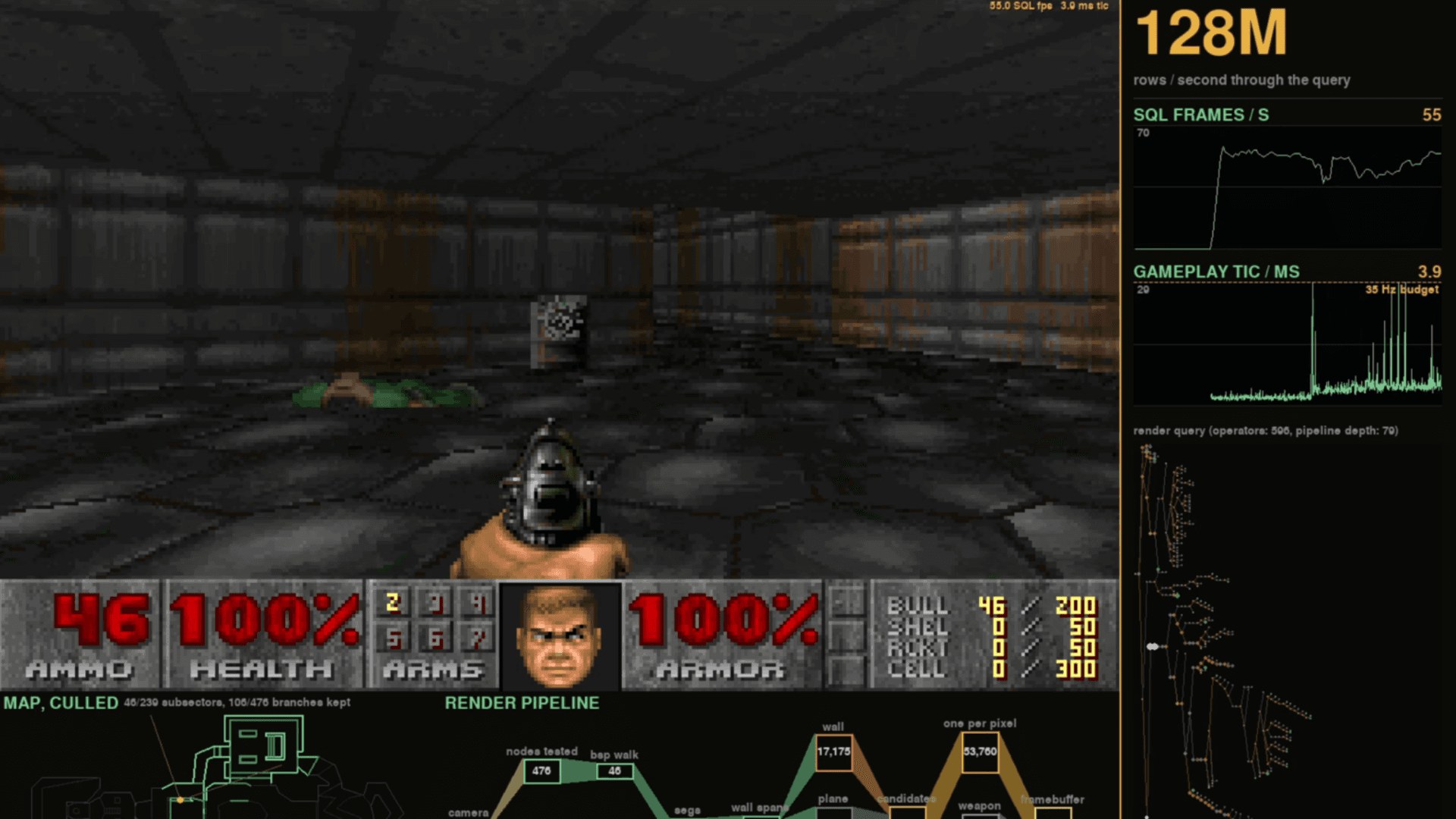
Developer Lukas Vogel has successfully ported the classic game Doom to run entirely inside a SQL database. The project, dubbed SQLDoom, handles both game logic and rendering through SQL queries and achieves playable frame rates. It also doubles as a technical showcase for CedarDB, a database system that compiles queries into machine code.

Editor, Lazyfounder
30 SEC SUMMARY
- Developer Lukas Vogel ported the classic game Doom to run entirely inside a SQL database, creating SQLDoom.
- SQLDoom renders 35 full-color frames per second at 640×480 resolution using about 1,300 lines of SQL code.
- The project supports multiplayer deathmatch with public servers in Europe and the U.S.
- Performance varies, with 60 fps on high-end hardware but dropping in busy scenes.
- The port also showcases CedarDB, a database system that compiles queries into machine code.
TABLE OF CONTENTS
KEY HIGHLIGHTS
- Lukas Vogel’s SQLDoom project runs Doom inside a SQL database, handling game logic and rendering through SQL queries.
- The port achieves 35 full-color frames per second at 640×480 resolution using approximately 1,300 lines of SQL code.
- An earlier version, DoomQL, used raycasting and resembled Wolfenstein 3D more than Doom.
- SQLDoom supports online deathmatch play with public servers in Europe and the United States.
- Performance reaches 60 fps on a Ryzen 7 7840U laptop but drops to 35 fps in busy scenes.
How Doom runs inside a SQL database
Developer Lukas Vogel has ported the classic game Doom to run entirely within a SQL database, a project he calls SQLDoom. According to TechRadar, the port uses approximately 1,300 lines of SQL code divided across 89 query blocks to handle both game logic and rendering. The result is a playable version of Doom that produces 35 full-color frames per second at 640×480 resolution.
Vogel’s earlier attempt, DoomQL, relied on raycasting and rendered graphics using grayscale text characters, resembling Wolfenstein 3D more than Doom. SQLDoom, however, implements proper Binary Space Partitioning (BSP) tree traversal, bringing it closer to the original game’s mechanics.
Performance and multiplayer functionality
SQLDoom delivers varying performance depending on the hardware and scene complexity. According to TechRadar, Vogel reported achieving 60 frames per second on a laptop equipped with a Ryzen 7 7840U processor. However, performance drops to around 35 frames per second in busy scenes, such as those with multiple enemies or projectiles.
The port supports online deathmatch multiplayer, with public servers available in Europe and the United States. TechRadar noted that reviewers who tested the demos described sluggish performance, though they suggested the issue might stem from the servers rather than the SQL port itself.
Vogel argued that using a database for game state management ensures consistency, eliminating issues like partially applied updates, physics bugs, or disputes over hit detection.
A showcase for CedarDB
SQLDoom also serves as a technical demonstration for CedarDB, a database system that compiles complex SQL queries into machine code. This approach aims to optimize performance for demanding real-time applications, such as gaming.
The project highlights how unconventional use cases can push the boundaries of database technology, particularly for systems designed to handle high-throughput queries efficiently.
Background: SQL and unconventional computing
Porting games or other real-time applications to SQL databases is rare but not unprecedented. SQL databases are typically optimized for transactional processing and data retrieval rather than rendering or game logic. However, projects like SQLDoom demonstrate the potential for databases to handle complex, low-latency tasks when engineered creatively.
CedarDB, the database system used in this project, is designed to compile queries into machine code, reducing overhead and improving performance for specialized workloads.
What this means
Lazyfounder analysis — our interpretation, not reported fact.
SQLDoom is a creative technical feat that challenges conventional wisdom about what SQL databases can do. While it’s unlikely to replace traditional game engines, the project underscores the flexibility of modern database systems when pushed to their limits. For founders and engineers, it’s a reminder that constraints can spark innovation—even in domains where databases are rarely considered viable solutions.
The project also serves as a clever showcase for CedarDB, demonstrating how compiling queries into machine code can enable real-time performance. For startups building high-performance systems, this approach could offer inspiration for optimizing their own infrastructure. However, the performance trade-offs in SQLDoom highlight that even well-optimized databases may struggle with tasks they weren’t originally designed for, such as rendering or physics simulations.
Key takeaways
- This project demonstrates the unexpected flexibility of SQL databases for real-time applications like gaming.
- Founders and engineers can draw inspiration from creative technical demos to push boundaries in their own systems.
- Performance trade-offs in unconventional computing environments highlight the importance of optimization.
- Multiplayer functionality in SQLDoom shows how databases can manage shared state in distributed applications.
- Such projects can serve as effective showcases for underlying technologies like CedarDB.
FAQ
Why would someone port Doom to a SQL database?
The project demonstrates the flexibility of SQL databases for real-time applications and serves as a technical showcase for CedarDB, a database system that compiles queries into machine code. It also highlights creative problem-solving in software development.
Can SQLDoom be played online?
Yes, SQLDoom supports online deathmatch multiplayer with public servers available in Europe and the United States.
How does SQLDoom perform?
Performance varies: it achieves 60 frames per second on a Ryzen 7 7840U laptop but drops to 35 fps in busy scenes. Reviewers reported sluggish performance in some online demos, though this may be due to server limitations rather than the SQL port itself.
What is CedarDB?
CedarDB is a database system that compiles complex SQL queries into machine code, optimizing performance for demanding real-time applications like gaming.
Related on Lazyfounder
Sources
- TechRadar · 2026-10-08
You can now play Doom on a SQL database in one of the most astonishing porting projects we've ever seen
This story is an original summary drafted with AI by Lazyfounder from the reporting listed above and checked by automated validation. Facts are attributed to their original publishers; sections marked as analysis are Lazyfounder's. Where a source is in another language, facts were machine-translated and quotations are reported, not reproduced. Read the original coverage via the links, and see our AI policy and corrections policy.

About the author
Editor, Lazyfounder
Tarun Mottlia edits LazyFounders, covering Indian startups, funding rounds, AI and product launches. Every story on the site is AI-assisted and checked against its cited sources before publication.
More stories by Tarun MottliaGet the LazyFounder Brief
Startup, funding and AI news in a five-minute read. Join the early-access list.