
Caterpillar and CoreWeave partner to accelerate physical AI for construction
Caterpillar Inc. and CoreWeave Inc. have joined forces to advance physical AI for construction machinery, targeting the unique challenges of unstructured environments. The partnership leverages CoreWeave’s GPU capacity and Caterpillar’s federated data ecosystem to shorten the learning loop for autonomous equipment, aiming to reduce training times from months to hours.

Editor, Lazyfounder
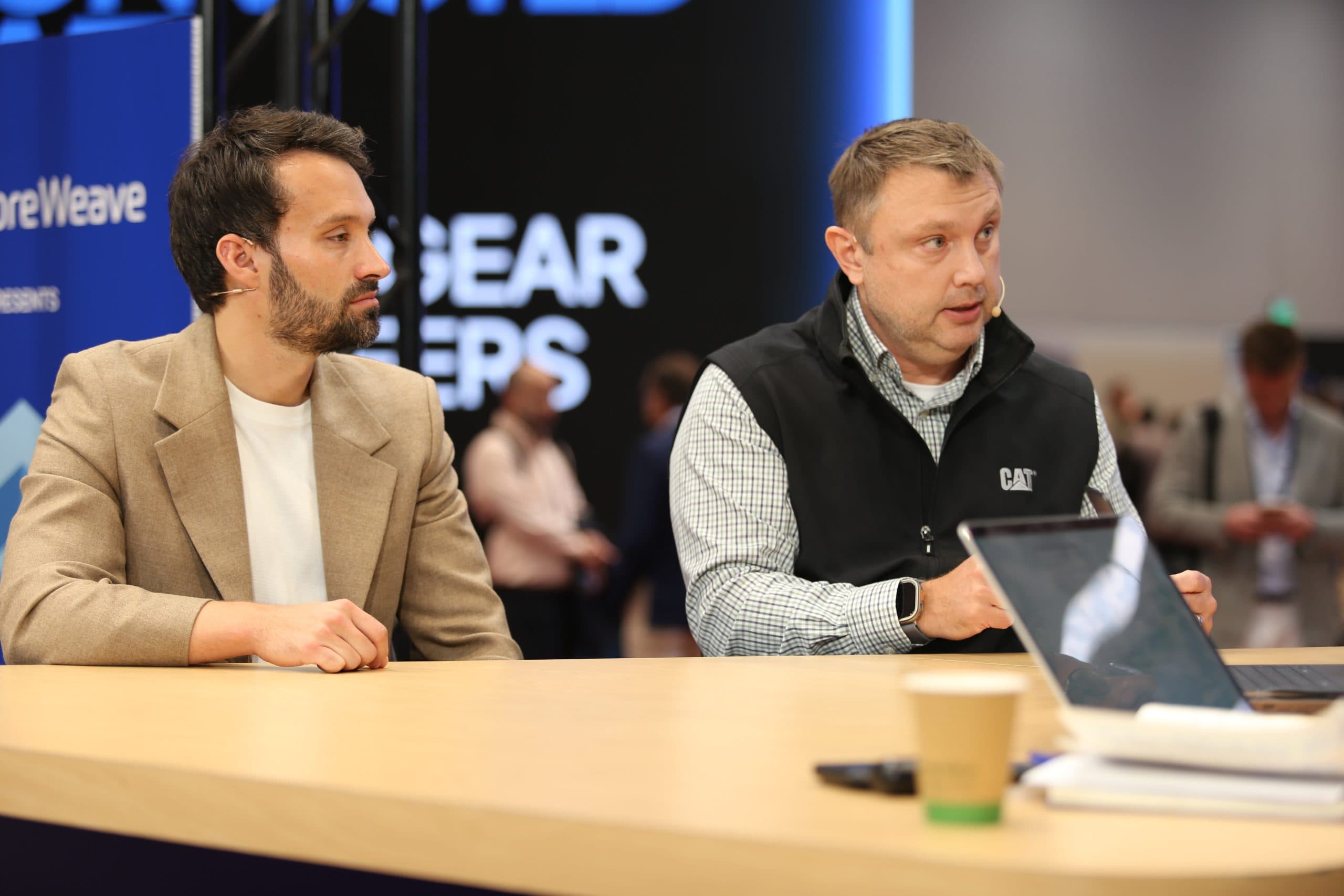
Caterpillar Inc. and CoreWeave Inc. have joined forces to advance physical AI for construction machinery, targeting the unique challenges of unstructured environments. The partnership leverages CoreWeave’s GPU capacity and Caterpillar’s federated data ecosystem to shorten the learning loop for autonomous equipment, aiming to reduce training times from months to hours.
30 SEC SUMMARY
- Caterpillar Inc. and CoreWeave Inc. have partnered to advance physical AI for construction machinery, focusing on autonomous equipment in unstructured environments.
- The collaboration leverages CoreWeave’s GPU capacity and Caterpillar’s federated data ecosystem to accelerate AI training and simulation.
- Construction’s unstructured environments pose unique challenges for autonomy, unlike mining’s structured settings.
- The partnership aims to reduce data annotation and training times from months to hours using AI models.
- Demand for infrastructure like data centers and highways is driving innovation in construction technology.
TABLE OF CONTENTS
- Partnership targets construction autonomy
- Physical AI as a solution for construction challenges
- Background and industry context
- What this means
- Key takeaways
- FAQ
- Sources
KEY HIGHLIGHTS
- Caterpillar Inc. and CoreWeave Inc. have partnered to advance physical AI for autonomous construction equipment.
- The collaboration focuses on shortening the learning loop for machines in unstructured environments, a challenge mining autonomy hasn’t faced.
- CoreWeave’s GPU infrastructure and Physical AI Field Engineering service will support faster data annotation and simulation.
- Caterpillar’s federated data ecosystem, holding 18 petabytes of data, provides a foundation for training AI models.
- Construction’s demand for infrastructure projects is driving innovation in autonomy and AI-driven workflows.
Partnership targets construction autonomy
Caterpillar Inc. and CoreWeave Inc. have announced a partnership to advance physical AI for construction machinery, aiming to accelerate the development of autonomous equipment in unstructured environments. The collaboration combines CoreWeave’s graphics processing unit (GPU) capacity with Caterpillar’s extensive federated data ecosystem, which holds approximately 18 petabytes of data from machines, dealers, and customers.
According to SiliconANGLE, the partnership seeks to address the unique challenges of construction, where conditions are far less predictable than in mining. Caterpillar has years of experience deploying autonomous equipment in mining but extending this technology to construction requires systems capable of adapting to highly variable environments. Brandon Hootman, Caterpillar’s Vice President of Physical AI Platforms and Construction Autonomy, emphasized the difficulty of applying structured autonomy solutions to unstructured settings, describing it as "really, really challenging."
Physical AI as a solution for construction challenges
The demand for new data centers, highways, and power plants is driving a construction boom, but the industry faces declining productivity and a shortage of skilled machine operators. Physical AI is emerging as a potential solution to these challenges, with the goal of enabling machines to operate autonomously in dynamic and unpredictable environments.
Training autonomous construction equipment involves ingesting telemetry and vision data, simulating scenarios millions of times, and applying reinforcement learning. According to SiliconANGLE, this process is data-intensive, with a single machine capable of generating terabytes of data in a day. The partnership between Caterpillar and CoreWeave aims to streamline this process, reducing data annotation and training times from months to hours using AI models and GPU capacity.
CoreWeave recently launched its Physical AI Field Engineering service, which embeds its engineers with customers’ domain experts to accelerate development. The company’s GPU infrastructure, along with collaborations with Nvidia, will be used to annotate and label incoming field data, a critical step in training physical AI models.
Background and industry context
Caterpillar’s digital ecosystem already includes 18 petabytes of federated data, but training physical AI models at scale requires significantly more. The company began working with CoreWeave earlier this year, drawn by both the GPU provider’s capacity and its applied expertise in AI infrastructure.
In its second-quarter results announcement, CoreWeave named Caterpillar among its enterprise customers. The partnership reflects a broader trend of industries leveraging AI to address labor shortages and improve efficiency, particularly in sectors like construction where skilled operators are in short supply.
What this means
Lazyfounder analysis — our interpretation, not reported fact.
This partnership signals a meaningful shift in how industries like construction approach autonomy. Mining has long been the proving ground for autonomous equipment, but construction’s variability—unpredictable terrain, dynamic workflows, and human collaboration—demands a different kind of AI. CoreWeave’s GPU infrastructure and expertise in physical AI could help bridge that gap, but success hinges on more than just compute power.
For founders and operators, this collaboration highlights two critical takeaways. First, data quality and scale matter. Caterpillar’s 18 petabytes of federated data is a strong foundation, but training physical AI in unstructured environments requires far more. Startups in similar spaces should prioritize building robust data pipelines early. Second, simulation is the bottleneck. If the partners can truly cut training times from months to hours, it could set a new standard for how industries deploy autonomy. However, the real test will be whether these simulations translate to real-world performance—something that remains unproven outside controlled environments.
Key takeaways
- Caterpillar and CoreWeave are targeting the construction industry’s unique challenges with physical AI, aiming to improve productivity and address labor shortages.
- CoreWeave’s GPU capacity and Physical AI Field Engineering service are central to the partnership, enabling faster training and simulation.
- The collaboration seeks to reduce data annotation and training times dramatically, from months to hours.
- Construction’s unstructured environments require a different approach to autonomy compared to mining, where Caterpillar has more experience.
- Demand for infrastructure projects like data centers and highways is accelerating the need for innovation in construction technology.
FAQ
What is physical AI, and how does it apply to construction?
Physical AI refers to artificial intelligence systems designed to interact with and operate in the physical world, such as autonomous machinery. In construction, physical AI aims to enable equipment to perform tasks like digging, lifting, and grading in unstructured environments without human intervention.
Why is construction a harder environment for autonomy than mining?
Mining environments are typically structured, with predictable terrain and controlled workflows. Construction sites, however, are dynamic and unstructured, featuring uneven terrain, changing layouts, and interactions with human workers and other equipment. This variability makes it significantly harder to deploy autonomous systems.
How will CoreWeave’s GPU capacity support this partnership?
CoreWeave’s GPU infrastructure provides the computational power needed to process large volumes of data, run simulations, and train AI models efficiently. This capacity is critical for reducing the time required to annotate data and train autonomous systems, which can otherwise take months.
What are the expected outcomes of this partnership?
The partnership aims to shorten the learning loop for autonomous construction equipment, reducing data annotation and training times from months to hours. If successful, this could lead to faster deployment of autonomous machines in construction, improving productivity and addressing labor shortages.
Related on Lazyfounder
Sources
- SiliconANGLE · 2026-10-07
Caterpillar and CoreWeave shorten the learning loop for physical AI
This story is an original summary drafted with AI by Lazyfounder from the reporting listed above and checked by automated validation. Facts are attributed to their original publishers; sections marked as analysis are Lazyfounder's. Where a source is in another language, facts were machine-translated and quotations are reported, not reproduced. Read the original coverage via the links, and see our AI policy and corrections policy.

About the author
Editor, Lazyfounder
Tarun Mottlia edits LazyFounders, covering Indian startups, funding rounds, AI and product launches. Every story on the site is AI-assisted and checked against its cited sources before publication.
More stories by Tarun MottliaGet the LazyFounder Brief
Startup, funding and AI news in a five-minute read. Join the early-access list.
