
BBC Tech Life episode explores semiconductor innovation, AI policy, and drones
The latest episode of the BBC World Service’s Tech Life series dives into three key areas of technological advancement: semiconductor manufacturing, AI policy, and drone applications. The episode features a visit to a plant producing ultra-thin and flexible chips, an interview with Canada’s AI Minister, and a segment on drones monitoring fire-damaged landscapes.

Editor, Lazyfounder
30 SEC SUMMARY
- A recent episode of Tech Life from the BBC World Service explores advancements in semiconductor technology, AI policy, and drone applications.
- The episode includes a visit to a semiconductor plant producing ultra-thin and flexible chips, showcasing cutting-edge manufacturing.
- Canada’s AI Minister is interviewed about the country’s approach to AI regulation and innovation.
- Drones are highlighted for their role in monitoring fire-damaged landscapes, demonstrating practical applications of aerial technology.
TABLE OF CONTENTS
KEY HIGHLIGHTS
- The BBC World Service’s Tech Life episode features a semiconductor plant producing super-thin and flexible chips.
- Canada’s AI Minister speaks to the BBC about the country’s AI strategy and policy directions.
- Drones are used to monitor fire-damaged landscapes, showcasing their role in environmental monitoring.
- Shiona McCallum presents the episode, with Tom Quinn serving as the producer.
Semiconductor plant produces ultra-thin, flexible chips
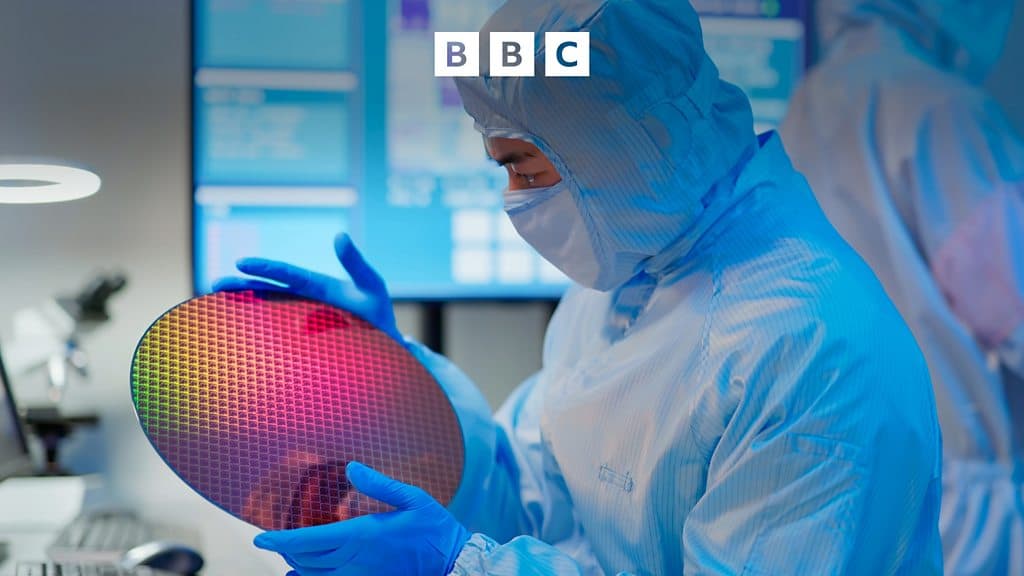
According to BBC News (Tech & Business), the latest episode of Tech Life on the BBC World Service includes a segment from a semiconductor manufacturing plant. The plant is producing super-thin and flexible chips, a technology with potential applications in wearable devices, medical sensors, and bendable electronics. The episode shows a technician inspecting a wafer containing thousands of microchips while wearing protective clothing, highlighting the precision and scale of modern semiconductor manufacturing.
Canada’s AI Minister discusses policy in BBC interview
The episode also features an interview with Canada’s AI Minister, as reported by BBC News (Tech & Business). The discussion reportedly focuses on Canada’s approach to AI regulation, innovation, and the country’s role in the global AI landscape. The interview is part of the BBC’s broader coverage of how governments are shaping AI policy to balance innovation with ethical considerations.
Drones monitor fire-damaged landscapes
Another segment of the episode highlights the use of drone technology for environmental monitoring. According to the BBC, drones are being deployed to survey fire-damaged landscapes, providing data for recovery efforts and risk assessment. This application demonstrates the growing role of aerial technology in disaster response and environmental management.
Episode details and contributors
The episode is presented by Shiona McCallum and produced by Tom Quinn, both of the BBC. Their work is part of the Tech Life series, which explores technology trends and innovations with a global perspective.
Context on BBC World Service’s technology coverage
The BBC World Service is a global broadcaster that regularly covers technology, innovation, and policy. Its programs often feature interviews with industry leaders, policymakers, and experts to provide insights into emerging trends. The Tech Life series, in particular, focuses on how technology intersects with daily life, business, and environmental challenges.
What this means
Lazyfounder analysis — our interpretation, not reported fact.
This episode of Tech Life reflects how rapidly technology is evolving across multiple sectors. For founders and operators, the segments offer a snapshot of where innovation is headed—and where opportunities might lie.
The focus on ultra-thin and flexible semiconductors signals a shift toward more adaptable hardware, which could unlock new product categories in wearables, healthcare, and even consumer electronics. Startups in these spaces may find value in exploring partnerships with semiconductor manufacturers to leverage these advancements.
Canada’s approach to AI policy, as discussed in the interview, is particularly relevant for founders navigating regulatory landscapes. Governments worldwide are grappling with how to foster innovation while addressing ethical concerns, and Canada’s strategy could serve as a model—or a cautionary tale—for other markets.
The drone segment underscores how technology is being applied to real-world problems, like environmental monitoring. For startups in sectors such as agriculture, disaster response, or infrastructure, this is a reminder that practical, scalable use cases often gain traction faster than abstract innovations. The key takeaway? Technology doesn’t exist in a vacuum; its value is determined by how well it solves tangible problems.
Key takeaways
- Ultra-thin and flexible semiconductor technology could enable new categories of products, particularly in wearables, healthcare, and consumer electronics. Founders should monitor advancements in this space for potential applications.
- Government AI policies, like those discussed by Canada’s AI Minister, are shaping the regulatory environment. Founders in AI-driven industries should stay informed about policy developments to anticipate compliance requirements or opportunities.
- Drones are proving their utility in environmental monitoring and disaster response. Startups in sectors like agriculture, infrastructure, or emergency services may find opportunities in developing drone-based solutions.
- The episode highlights the importance of practical applications for technology. Founders should prioritize solving real-world problems over pursuing innovation for its own sake.
Related on Lazyfounder
Sources
- BBC News (Tech & Business) · 2026-10-20
Tech Life - Beyond silicon chips - BBC Sounds
This story is an original summary drafted with AI by Lazyfounder from the reporting listed above and checked by automated validation. Facts are attributed to their original publishers; sections marked as analysis are Lazyfounder's. Where a source is in another language, facts were machine-translated and quotations are reported, not reproduced. Read the original coverage via the links, and see our AI policy and corrections policy.

About the author
Editor, Lazyfounder
Tarun Mottlia edits LazyFounders, covering Indian startups, funding rounds, AI and product launches. Every story on the site is AI-assisted and checked against its cited sources before publication.
More stories by Tarun MottliaGet the LazyFounder Brief
Startup, funding and AI news in a five-minute read. Join the early-access list.
