
Bayer wins first Roundup cancer trial after US Supreme Court narrows plaintiffs’ claims
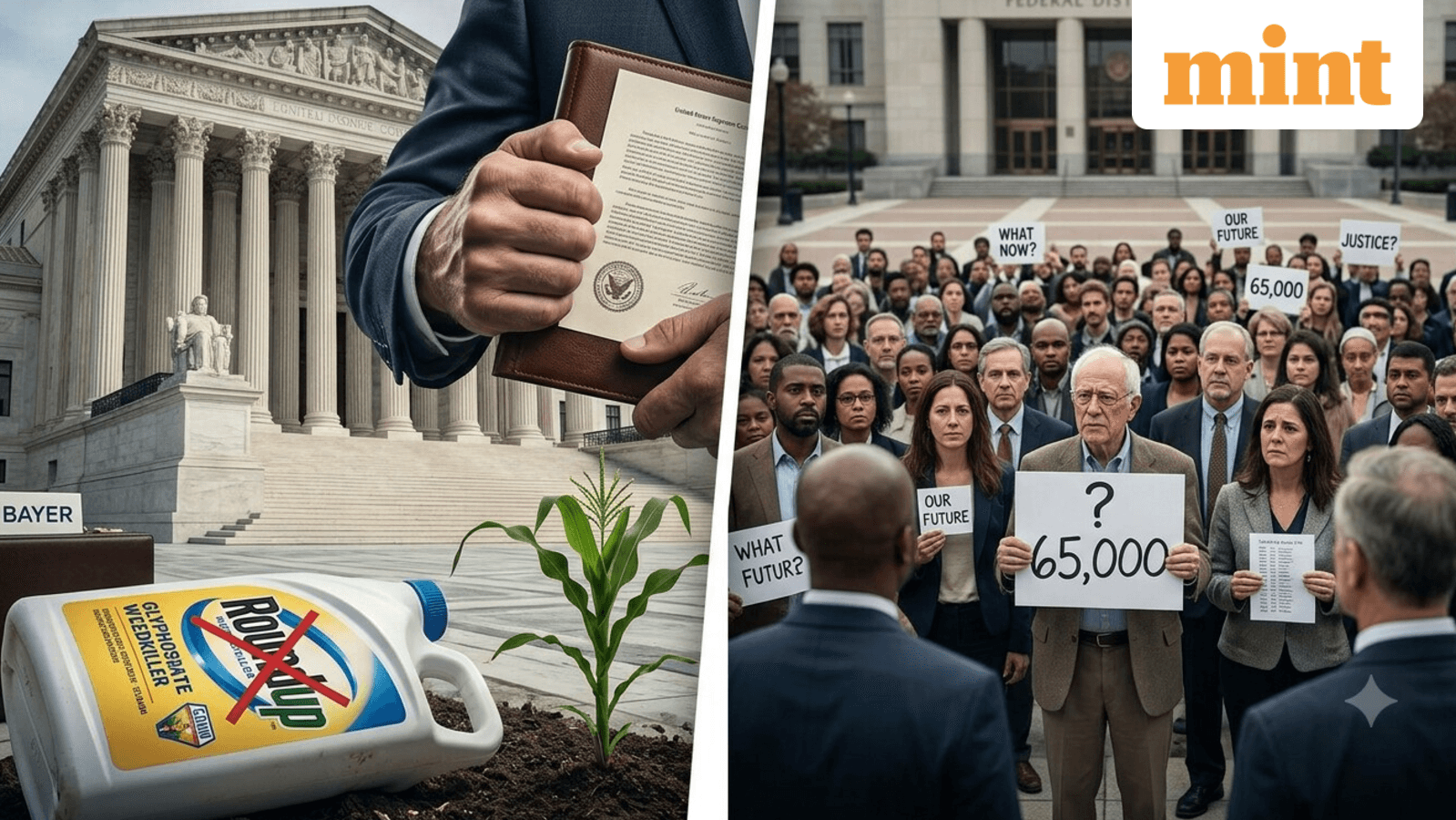
Bayer has won its first US trial over claims that its Roundup weedkiller causes cancer, a verdict shaped by a recent US Supreme Court ruling that limited the legal arguments available to plaintiffs. The case involved three women who alleged Roundup caused their non-Hodgkin lymphoma, and its outcome may influence the trajectory of roughly 65,000 pending lawsuits against the company.

Editor, Lazyfounder
KEY HIGHLIGHTS
- A St. Louis jury ruled in Bayer’s favor in the first Roundup cancer risk trial since a US Supreme Court ruling restricted plaintiffs’ legal arguments.
- Bayer faces approximately 65,000 pending lawsuits alleging Roundup weedkiller causes non-Hodgkin lymphoma.
- The Supreme Court’s June ruling barred failure-to-warn claims, as Roundup’s label aligns with EPA approvals.
- Bayer is pursuing a $7.25 billion settlement to resolve tens of thousands of remaining lawsuits.
Verdict follows Supreme Court ruling on label claims
A jury in St. Louis unanimously ruled in favor of Bayer-owned Monsanto in a lawsuit brought by three women—Theresa Aretino, Cynthia Fernandez, and Betty Larkin—who claimed regular use of Roundup caused their non-Hodgkin lymphoma. Fernandez died before the trial began.
The case marks the first test of Roundup litigation since the US Supreme Court’s June ruling, which blocked plaintiffs’ arguments that the product’s label failed to warn about cancer risks. The court held that federal law requires herbicide manufacturers to use the label approved by the US Environmental Protection Agency (EPA), which does not mandate a cancer warning for Roundup.
Bayer has argued that the Supreme Court’s decision also preempts other claims, such as design defects and negligence, though plaintiffs’ lawyers dispute this interpretation.
Implications for pending lawsuits and settlement
The verdict comes as Bayer seeks to resolve roughly 65,000 pending Roundup lawsuits through a proposed $7.25 billion settlement, currently under review by a Missouri state court judge. The three plaintiffs in the St. Louis trial were not part of this settlement.
Bayer maintains that decades of studies, including EPA reviews, show glyphosate—the active ingredient in Roundup—is safe and not carcinogenic. However, the International Agency for Research on Cancer classified glyphosate as "probably carcinogenic" in 2015, a finding Bayer has dismissed as flawed.
The litigation has weighed heavily on Bayer since its 2018 acquisition of Monsanto, costing billions in legal expenses and contributing to declines in its share price.
What this means
Lazyfounder analysis — our interpretation, not reported fact.
This verdict is a critical development for Bayer and companies operating in regulated industries, particularly those facing litigation over product safety. The US Supreme Court’s ruling has narrowed the legal avenues plaintiffs can pursue, shifting focus away from failure-to-warn claims and toward arguments like design defects or negligence—though Bayer argues these, too, are preempted by federal law. For founders and operators, the case underscores how regulatory alignment can serve as a defense in litigation, but it also highlights the risks of operating in sectors where scientific consensus is contested.
The proposed $7.25 billion settlement, if approved, could set a precedent for resolving mass tort claims, offering a framework for other companies facing similar legal challenges. However, the persistent divide between regulatory agencies (e.g., the EPA and the International Agency for Research on Cancer) demonstrates how scientific disagreements can prolong legal and reputational risks.
Key takeaways
- The Supreme Court’s ruling restricts plaintiffs’ ability to argue failure-to-warn claims, potentially reshaping Roundup litigation strategy.
- Founders in regulated industries (agrochemicals, pharmaceuticals, consumer products) should note how regulatory compliance can limit litigation risks—but also how scientific disputes (e.g., glyphosate’s carcinogenicity) prolong legal exposure.
- The $7.25 billion settlement proposal could serve as a benchmark for resolving mass tort claims; operators facing similar risks may study its structure for their own legal strategies.
Related on Lazyfounder
Sources
- Mint (Technology) · 2026-10-30
Bayer wins first Roundup cancer trial after US Supreme Court ruling: What changes for 65,000 claimants?
This story is an original summary drafted with AI by Lazyfounder from the reporting listed above and checked by automated validation. Facts are attributed to their original publishers; sections marked as analysis are Lazyfounder's. Where a source is in another language, facts were machine-translated and quotations are reported, not reproduced. Read the original coverage via the links, and see our AI policy and corrections policy.

About the author
Editor, Lazyfounder
Tarun Mottlia edits LazyFounders, covering Indian startups, funding rounds, AI and product launches. Every story on the site is AI-assisted and checked against its cited sources before publication.
More stories by Tarun MottliaGet the LazyFounder Brief
Startup, funding and AI news in a five-minute read. Join the early-access list.
