
India Leads Global Workforce Transformation with AI: 2026 Trends
Discover how India is leading global workforce transformation with AI in 2026, according to the Microsoft Work Trend Index. Explore the rise of frontier professionals and AI's impact.
LazyFounders

30 SEC SUMMARY
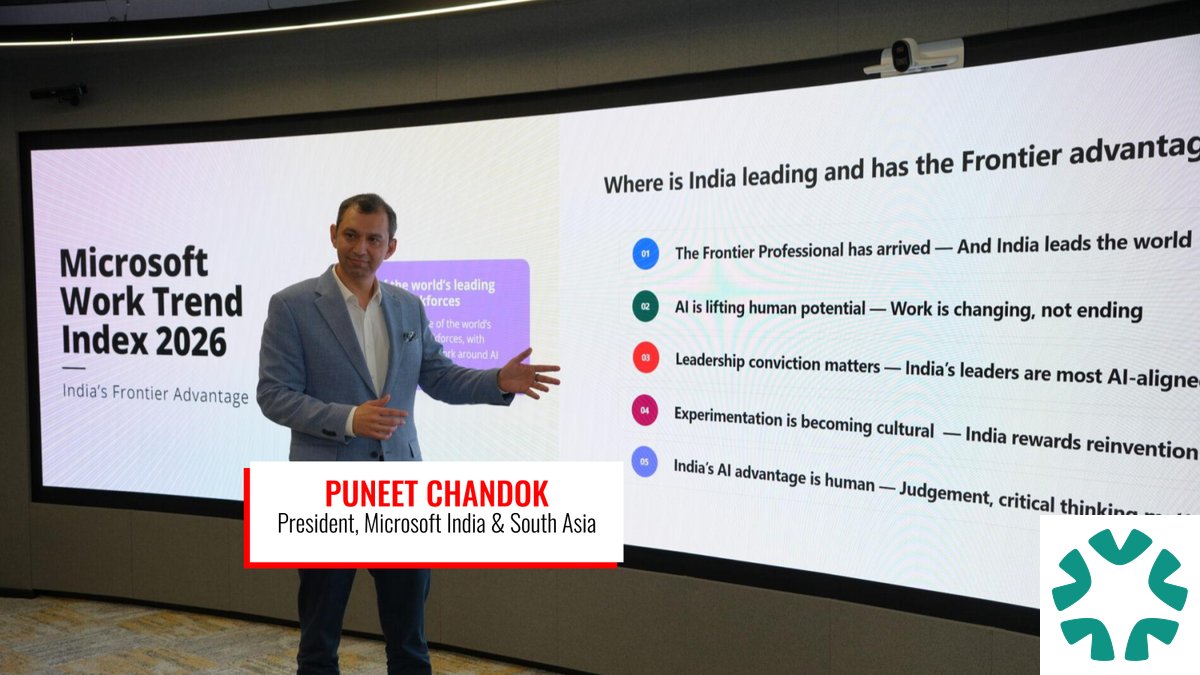
India is at the forefront of global workforce transformation with AI, according to the Microsoft 2026 Work Trend Index. With nearly a third of Indian professionals qualifying as 'frontier professionals,' the nation is leading the world in integrating AI into complex workflows. This shift is redefining daily tasks, emphasizing human judgment over automation, and driving productivity gains across major IT firms.
TABLE OF CONTENTS
- Introduction
- Emergence of Frontier Professionals
- The Unique Human Advantage
- A Culture of Reinvention
- Scaling Up to Frontier Enterprise
- Measuring the ROI
- Conclusion
- Call-to-Action
KEY HIGHLIGHTS
- India has one of the world’s largest frontier workforces.
- 32% of Indian AI users are frontier professionals.
- Indian workers prioritize quality control and critical thinking.
- Major IT firms in India are scaling AI adoption.
- AI deployments yield significant productivity improvements.
Introduction
India has emerged as a global leader in workforce transformation, according to the Microsoft 2026 Work Trend Index. This report highlights how professionals across Indian offices are moving beyond basic AI tasks to manage complex, automated workflows.
Emergence of Frontier Professionals
The study, which surveyed 20,000 AI users across 10 markets, reveals that India has one of the world’s largest frontier workforces. Frontier professionals are those who design and manage multi-step systems using AI agents, balancing automation with strong human judgment.
Nearly a third of Indian professionals who took part in the survey qualify as 'frontier professionals,' double the global average of 16% and the highest among the markets studied. This leap from 2025, when business leaders merely expressed intent to build human-agent teams at scale, has now turned into reality, creating new kinds of high-value work.
The Unique Human Advantage
Despite the rapid adoption of highly automated systems, the findings show that Indian workers refuse to hand over final responsibility. Even as automation becomes increasingly sophisticated, human judgment is becoming more, not less, valuable, the study shows.
Indian AI users lead the world in prioritizing quality control of automated outputs. Nearly two-thirds rank evaluating AI-generated work as a critical skill, compared to half globally. Furthermore, 59% of Indian professionals place a premium on critical thinking, which is significantly higher than the global average of 46%. Crucially, almost 9 in 10 respondents in India assert that they remain fully responsible for the thinking, treating the material generated by systems as merely a starting point.
A Culture of Reinvention
More than 4 in 10 Indian workers feel their company leaders have a clear and unified plan on how to use AI, nearly double the global average. Managers are actively involved in AI usage, with both frontier managers (91%) and non-frontier managers (81%) using the technology.
Frontier managers redesign team workflows to incorporate AI agents and automation. On the other hand, non-frontier managers mostly stick to traditional management methods and adopt/support AI, but with less intensity than frontier managers. All this is backed by a corporate culture that rewards reinvention. One in four Indian organizations rewards employees for workflow reinvention without immediate commercial results, compared with just one in eight globally.
Scaling Up to Frontier Enterprise
Scaling across large, complex operations is the ultimate test of AI adoption. In India, major IT firms are demonstrating how to transition from small-scale pilots to full enterprise transformation.
In under six months, Infosys, TCS, Wipro, and LTIMindtree have collectively licensed over 4 lakh seats of Microsoft 365 Copilot, a generative assistant integrated into daily work applications. Infosys is expanding its copilot implementation to over 1 lakh employees, achieving a monthly active usage rate of 91% across delivery, engineering, and corporate divisions.
Measuring the ROI
AI deployments are yielding quantifiable productivity improvements across Indian enterprises. At TCS, almost 9 in 10 licensed associates use the technology daily. TCS reports productivity gains of 20-to 25% in research and content production, and a 25-35% reduction in process cycle times.
Wipro’s monthly active usage exceeds 95%, saving an average of 2,50,000 full-time-equivalent days per quarter, where each day represents the work of one employee for one working day. The company has also democratized agent building, with employees creating over 29,000 custom, end-user developed agents alongside 60 enterprise-grade solutions. Wipro and Persistent Systems have launched large-scale training programs to ensure their entire workforce is fully prepared to use AI.
Conclusion
India's leadership in workforce transformation with AI is reshaping the daily grind of employees, moving them from repetitive work to high-value supervision. The unique human advantage, a culture of reinvention, and significant productivity gains underscore the nation's pioneering role in this global trend.
Call-to-Action
Ready to explore more about AI's impact on the workforce? Visit blogy.in for the latest insights and trends.
Internal Links:
- Microsoft 2026 Work Trend Index
- Infosys AI Initiatives
- TCS AI Solutions
- Wipro AI Programs
- LTIMindtree AI Services
- Persistent Systems AI Training
External Link:
Inline Images:
FAQ Section
**Q1: What are frontier professionals? A1: Frontier professionals are those who design and manage multi-step systems using AI agents, balancing automation with strong human judgment.
**Q2: How is AI transforming the Indian workforce? A2: AI is transforming the Indian workforce by enabling professionals to manage complex, automated workflows, moving from repetitive work to high-value supervision.
**Q3: What are the benefits of AI adoption in Indian enterprises? A3: AI adoption in Indian enterprises leads to productivity gains, reduced process cycle times, and significant savings in full-time-equivalent days.
Sources
This story is an original summary and analysis written by LazyFounders from the reporting listed above. Facts are attributed to their original publishers; sections marked as analysis are LazyFounders's opinion. Where a source is in another language, facts were machine-translated and quotations are reported, not reproduced. Read the original coverage via the links.
