
Alibaba’s QwenBook and V900 AI Chip Redefine Computing and Infrastructure
Alibaba has unveiled a pair of ambitious products—a laptop and an AI chip—that push the boundaries of how devices interact with operating systems and hardware. The QwenBook, an AI-centric laptop, uses a chatbot interface to run multiple OS environments simultaneously, while the Zhenwu V900 AI chip aims to challenge Nvidia’s dominance in China’s restricted market. Both products reflect Alibaba’s strategic focus on AI, though their success remains uncertain.
Editor, LazyFounders

Alibaba has unveiled a pair of ambitious products—a laptop and an AI chip—that push the boundaries of how devices interact with operating systems and hardware. The QwenBook, an AI-centric laptop, uses a chatbot interface to run multiple OS environments simultaneously, while the Zhenwu V900 AI chip aims to challenge Nvidia’s dominance in China’s restricted market. Both products reflect Alibaba’s strategic focus on AI, though their success remains uncertain.
30 SEC SUMMARY
- Alibaba unveiled the QwenBook, an AI-centric laptop that uses a chatbot interface to run multiple operating systems simultaneously, including Windows, Android, and Linux.
- The QwenBook is powered by Qualcomm’s Snapdragon 8 Elite Gen 5 chip and Alibaba’s Qwen3.8-Max AI model, which has 2.4 trillion parameters.
- Alibaba also introduced the Zhenwu V900 AI chip, claiming it as China’s most powerful AI chip, with plans to scale AI clusters to 500,000 chips.
- The QwenBook is unlikely to be available in the U.S. market due to geopolitical and supply chain constraints.
- Alibaba Cloud plans to expand its data center capacity to over 20GW by 2032, up from roughly 4GW currently.
TABLE OF CONTENTS
- Alibaba Unveils QwenBook, an AI-Centric Laptop
- Skepticism and Market Limitations
- Alibaba’s AI Chip Ambitions
- Challenges and Competition
- Context: The AI Hardware Landscape
- What this means
- Key takeaways
- FAQ
- Sources
KEY HIGHLIGHTS
- Alibaba showcased the QwenBook, an AI-centric laptop that uses a chatbot interface to run Windows, Android, and Linux simultaneously.
- The QwenBook is powered by Qualcomm’s Snapdragon 8 Elite Gen 5 chip and Alibaba’s Qwen3.8-Max AI model, which has 2.4 trillion parameters.
- Alibaba introduced the Zhenwu V900 AI chip, claiming it as China’s most powerful, with plans to scale AI clusters to 500,000 chips.
- The QwenBook is unlikely to be available in the U.S. due to geopolitical and supply chain constraints.
- Alibaba Cloud aims to expand its data center capacity to over 20GW by 2032, up from roughly 4GW today.
Alibaba Unveils QwenBook, an AI-Centric Laptop
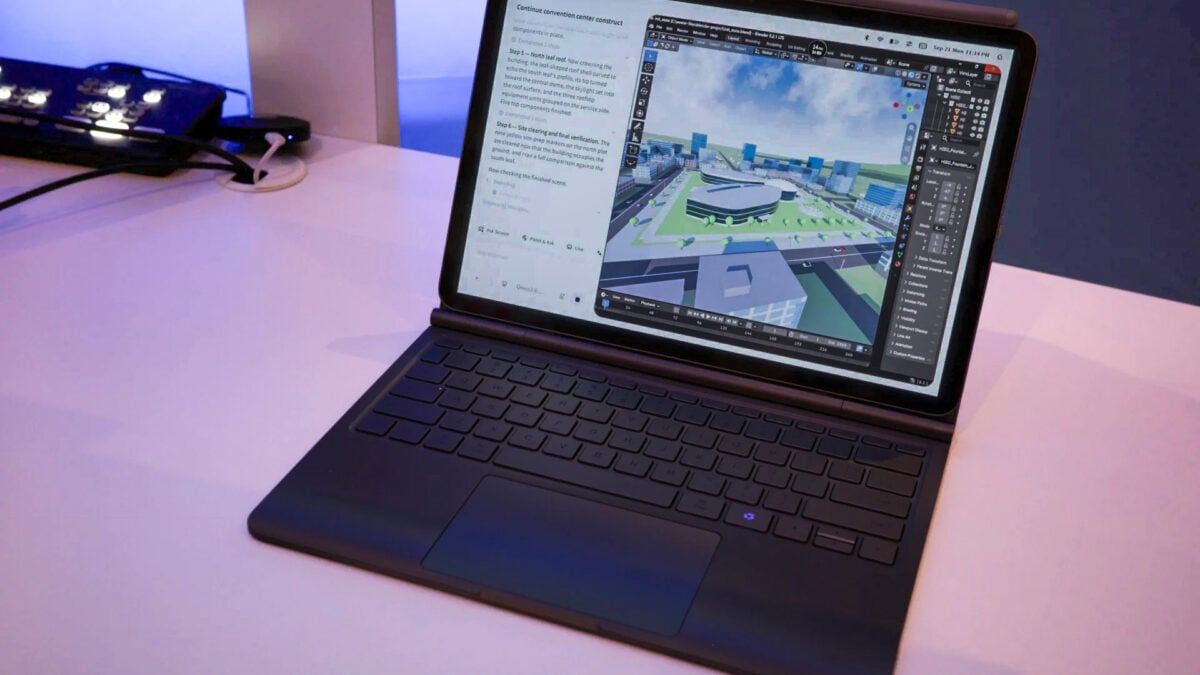
At the Snapdragon Summit 2026, Alibaba introduced the QwenBook, a laptop designed to redefine computing through AI. According to Gizmodo, the QwenBook uses a chatbot interface to manage multiple operating systems, including Windows, Android, and Linux, simultaneously. This approach, described as "OS as a harness," leverages AI to handle backend processes and display outputs seamlessly.
The QwenBook is powered by Qualcomm’s Snapdragon 8 Elite Gen 5 chip, a mobile-derived processor similar to those used in high-end smartphones. It also integrates Alibaba’s Qwen3.8-Max, a massive 2.4 trillion parameter AI model, to enable both on-device and cloud-based AI tasks. Users can run apps from different operating systems at the same time, a feature that sets the QwenBook apart from traditional laptops.
The device includes a convertible design, with a tablet that magnetically attaches to a keyboard. It also features a small display on the back to show active tasks, even when the laptop is closed. Alibaba claims the QwenBook can perform agentic tasks independently, such as running processes in the background or being controlled remotely via a phone app.
Skepticism and Market Limitations
While the QwenBook has generated intrigue, skepticism surrounds its practicality and market reach. According to Gizmodo, the laptop is unlikely to be available in the U.S. market, likely due to geopolitical tensions and supply chain restrictions. The device also includes only a few native apps, such as a Linux terminal, calendar, and camera, raising questions about its readiness for mainstream adoption.
Reports suggest the QwenBook’s AI capabilities could extend to generating new apps on demand, though this claim remains unverified. The laptop’s reliance on a mobile chip, rather than a traditional laptop processor, may also limit its performance for resource-intensive tasks.
Alibaba’s AI Chip Ambitions
Alongside the QwenBook, Alibaba unveiled the Zhenwu V900 AI chip, which it claims is China’s most powerful AI accelerator. According to TechRadar, the V900 features 216GB of memory and 1.2TB/s of chip-to-chip bandwidth. Alibaba states the chip triples the performance of its predecessor, the M890, though it has not disclosed key details such as FLOPS, power consumption, or the process node used.
Alibaba’s T-Head subsidiary, led by Vice President Gao Hui, plans to scale the V900 to AI clusters of up to 500,000 chips. However, this target may be theoretical, as it would require nearly as many chips as Alibaba has shipped in its entire history. The company also faces supply chain constraints, which could limit its ability to meet this goal.
The V900 is positioned as a competitor to Nvidia’s GPUs, particularly in China, where U.S. sanctions have restricted access to Nvidia’s latest hardware. Alibaba Cloud, the company’s cloud computing arm, aims to expand its data center capacity to over 20GW by 2032, up from roughly 4GW today. This expansion is part of Alibaba’s broader strategy to dominate China’s AI infrastructure market.
Challenges and Competition
Alibaba’s AI ambitions face significant challenges, including competition from Huawei’s Ascend 960DT chip. According to TechRadar, Huawei’s chip offers detailed specifications, including 2 petaFLOPS of FP8 compute, 288GB of memory, and 9.6TB/s of memory bandwidth, making it a formidable rival to the V900.
Supply chain limitations further complicate Alibaba’s plans. The company has acknowledged that shortages may hinder its ability to scale its AI infrastructure. Additionally, geopolitical factors, such as U.S. sanctions on Nvidia, have created opportunities for local players like Alibaba and Huawei to fill the gap in China’s AI hardware market.
Despite these challenges, Alibaba remains committed to its AI strategy. The company plans to release new generations of AI chips annually, with the J900 expected in 2028. However, its ability to compete with global leaders like Nvidia and local rivals like Huawei will depend on overcoming supply chain barriers and demonstrating the V900’s capabilities in real-world applications.
Context: The AI Hardware Landscape
The QwenBook and V900 chip emerge at a time of intense competition in the AI hardware space. Global tech giants like Google, Apple, and Nvidia dominate the market, while Chinese companies such as Huawei and Alibaba are carving out niches in response to U.S. sanctions. These restrictions have limited China’s access to advanced GPUs, accelerating local innovation in AI chips and infrastructure.
Alibaba Cloud’s expansion plans reflect a broader trend of cloud providers investing heavily in data center capacity to support AI workloads. The shift toward AI-centric computing, as demonstrated by the QwenBook, signals a potential evolution in how devices interact with operating systems and applications, though widespread adoption remains uncertain.
What this means
LazyFounders analysis — our interpretation, not reported fact.
Alibaba’s QwenBook and Zhenwu V900 chip represent bold bets on the future of AI-driven computing and infrastructure. The QwenBook’s unconventional approach—using AI to manage multiple operating systems—could redefine user interactions with devices, but its success hinges on solving practical challenges like performance limitations and app ecosystem maturity. For founders, this is a reminder that innovation often requires trade-offs, especially when venturing into unproven territory.
The V900 chip, meanwhile, underscores China’s determination to reduce its dependence on foreign technology, particularly in the AI space. While Alibaba’s claims about the chip’s capabilities are ambitious, the lack of technical details raises questions about its competitiveness. For operators, this highlights the importance of transparency in hardware specifications, especially when vying for market share against established players like Nvidia or well-documented rivals like Huawei.
Ultimately, Alibaba’s announcements reflect both opportunity and risk. The QwenBook’s exclusion from the U.S. market limits its global impact, but its AI-driven design could resonate in China and other regions where access to cutting-edge hardware is restricted. For Alibaba, the real test will be whether it can turn these innovations into scalable, reliable products—or if they remain experimental proofs of concept.
Key takeaways
- Alibaba’s QwenBook represents an unconventional approach to computing, using AI to manage multiple operating systems through a chatbot interface.
- The QwenBook is powered by Qualcomm’s Snapdragon 8 Elite Gen 5 chip and Alibaba’s Qwen3.8-Max model, enabling on-device and cloud-based AI tasks.
- Alibaba’s Zhenwu V900 AI chip is positioned as a competitor to Nvidia’s GPUs, particularly in China’s restricted market.
- Supply chain limitations and competition from Huawei’s Ascend 960DT pose challenges to Alibaba’s AI infrastructure ambitions.
- Alibaba Cloud’s expansion plans highlight its commitment to scaling AI infrastructure despite geopolitical and logistical hurdles.
FAQ
What is the QwenBook?
The QwenBook is an AI-centric laptop developed by Alibaba. It uses a chatbot interface to run multiple operating systems, including Windows, Android, and Linux, simultaneously. The laptop is powered by Qualcomm’s Snapdragon 8 Elite Gen 5 chip and Alibaba’s Qwen3.8-Max AI model.
How does the QwenBook differ from traditional laptops?
Unlike traditional laptops, the QwenBook uses AI to manage operating systems and applications through a chatbot interface. This allows users to run apps from different OS environments at the same time, a feature not typically available in conventional devices.
What is the Zhenwu V900 AI chip?
The Zhenwu V900 is an AI chip developed by Alibaba’s T-Head subsidiary. Alibaba claims it is China’s most powerful AI accelerator, with 216GB of memory and 1.2TB/s of chip-to-chip bandwidth. It is positioned as a competitor to Nvidia’s GPUs, particularly in China’s restricted market.
Why is the QwenBook unlikely to be available in the U.S.?
The QwenBook is unlikely to launch in the U.S. due to geopolitical tensions and supply chain restrictions. These factors limit Alibaba’s ability to distribute the device in markets outside China.
How does the V900 compare to Huawei’s Ascend 960DT?
Huawei’s Ascend 960DT offers detailed specifications, including 2 petaFLOPS of FP8 compute and 288GB of memory, making it a strong competitor to the V900. Alibaba’s chip lacks publicly disclosed performance metrics, which could limit its appeal in comparison.
What are Alibaba’s plans for AI infrastructure expansion?
Alibaba Cloud plans to expand its data center capacity to over 20GW by 2032, up from roughly 4GW currently. This expansion is part of Alibaba’s strategy to scale its AI infrastructure, though supply chain limitations may pose challenges.
Related on LazyFounders
Sources
- Gizmodo · 2026-09-23
The ‘QwenBook’ Laptop Can Run Every OS at Once, and It May Be PC Fans’ Worst Nightmare - TechRadar · 2026-09-25
Alibaba wants to expand data center capacity past 20 GW by 2032, says its new V900 AI chip can scale to 500,000-card clusters, but will 'China's most powerful AI chip' be enough to displace Nvidia GPUs?
This story is an original summary drafted with AI by LazyFounders from the reporting listed above and checked by automated validation. Facts are attributed to their original publishers; sections marked as analysis are LazyFounders's. Where a source is in another language, facts were machine-translated and quotations are reported, not reproduced. Read the original coverage via the links, and see our AI policy and corrections policy.
Get the LazyFounder Brief
Startup, funding and AI news in a five-minute read. Join the early-access list.
