
Archaeologists unearth 2,700-year-old bone flute and 4,500-year-old idol head at Troy
Archaeologists conducting excavations at the ancient city of Troy in Türkiye have uncovered two significant artifacts: a 2,700-year-old bone flute fragment and a 4,500-year-old idol head. These discoveries provide new insights into the cultural and religious practices of Troy, a site best known for its association with the Trojan War and Homer's epic poems.

Editor, Lazyfounder
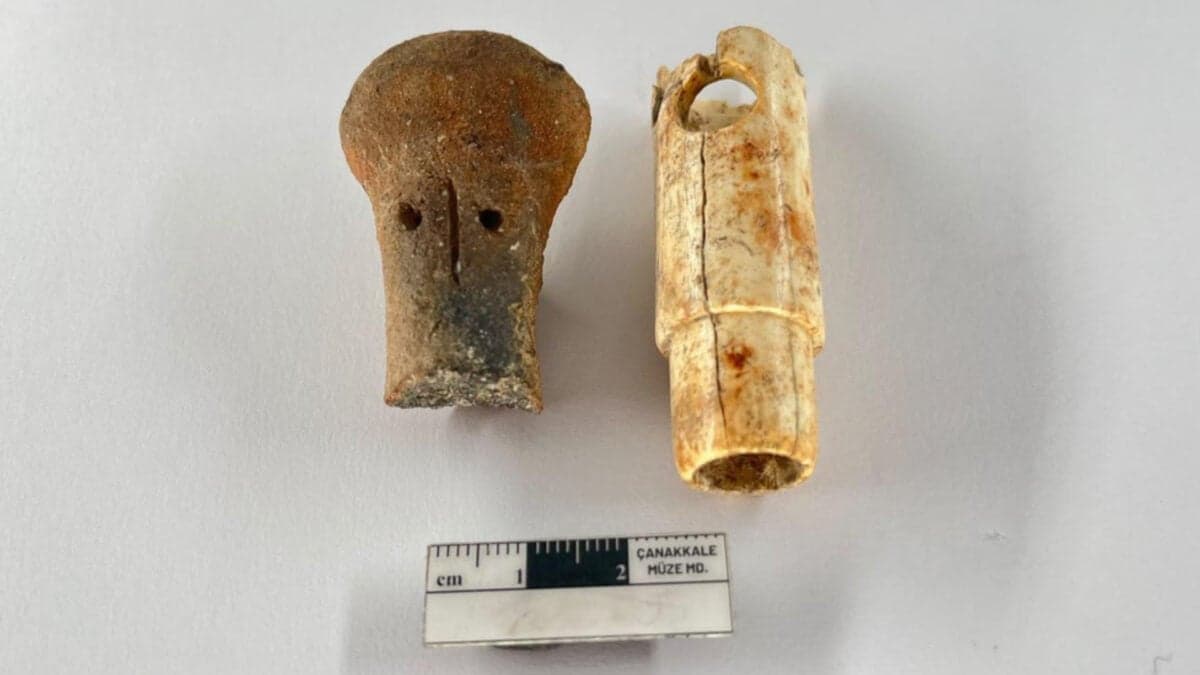
TABLE OF CONTENTS
Artifacts unearthed at Troy
Archaeologists from the Troy Excavation Project, led by Çanakkale Onsekiz Mart University, have discovered two artifacts that underscore the cultural richness of the ancient city of Troy in northwestern Türkiye. The finds include a 2,700-year-old bone flute fragment and a 4,500-year-old idol head, both of which predate or postdate the era of the Trojan War.
Details of the idol head
The idol head, dating to the Early Bronze Age (around 2500 BCE), was found beneath the floor of the FN Gate at Troy’s citadel. The artifact features a bulbous shape with two small holes and a straight line, representing eyes and a nose, along with a headdress. According to Gizmodo, such idols are often associated with female figures and religious practices in ancient societies.
The bone flute fragment
The bone flute fragment, dating to the 700s BCE, is the first identifiable musical instrument discovered at Troy. Wind instruments were commonly used in antiquity during festivals, religious ceremonies, and public celebrations. The fragment provides direct evidence of musical practices at Troy during the early first millennium BCE, as reported by Gizmodo.
Troy’s archaeological significance
Troy, first inhabited around 3600 BCE, spans nine distinct archaeological levels (Troy I–Troy IX). While the site is globally renowned for its connection to the Trojan War and Homer’s Iliad, these new discoveries highlight its broader historical and cultural significance. Experts often associate Homer’s Troy with the Late Bronze Age, particularly the late 1200s BCE, when the city was likely the prosperous capital of a regional kingdom known to the Hittites as ‘Wilusa.’
What this means
Lazyfounder analysis — our interpretation, not reported fact.
For founders and operators in the fields of historical research, tourism, and cultural heritage, these discoveries at Troy are a reminder of the depth and complexity of ancient civilizations. While Troy is often reduced to its mythological associations, its layered history offers opportunities for education, digital reconstruction, and storytelling. Startups in edtech, virtual reality, or heritage conservation might find value in exploring how such artifacts can be leveraged to create immersive experiences or enhance public engagement with history. The findings also underscore the importance of sustained archaeological research in uncovering narratives that extend far beyond popular myths.
Sources
- Gizmodo · 2026-10-30
Archaeologists at Ancient Troy Unearth a 2,700-Year-Old Bone Flute. Odysseus Never Heard It
This story is an original summary drafted with AI by Lazyfounder from the reporting listed above and checked by automated validation. Facts are attributed to their original publishers; sections marked as analysis are Lazyfounder's. Where a source is in another language, facts were machine-translated and quotations are reported, not reproduced. Read the original coverage via the links, and see our AI policy and corrections policy.

About the author
Editor, Lazyfounder
Tarun Mottlia edits LazyFounders, covering Indian startups, funding rounds, AI and product launches. Every story on the site is AI-assisted and checked against its cited sources before publication.
More stories by Tarun MottliaGet the LazyFounder Brief
Startup, funding and AI news in a five-minute read. Join the early-access list.
