
Aircall co-founder Olivier Pailhès returns as CEO to accelerate AI voice agents
Aircall has brought back co-founder Olivier Pailhès as CEO, replacing Scott Chancellor, to drive the company’s push into AI-powered voice agents for customer service. Aircall, which serves over 24,000 customers globally, aims to automate repetitive tasks while improving the reliability of AI-driven interactions.

Editor, Lazyfounder
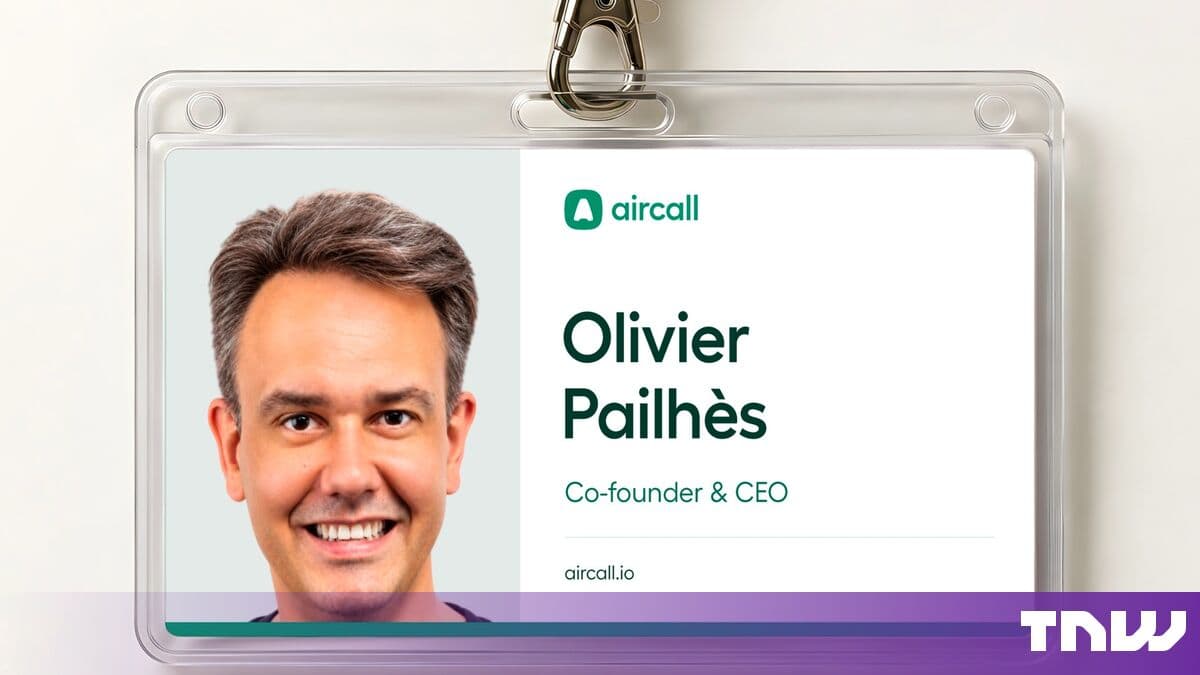
TABLE OF CONTENTS
Founder returns to lead AI push at Aircall
Olivier Pailhès, who co-founded Aircall in Paris in 2014, has resumed the role of CEO. He succeeds Scott Chancellor, whose departure reasons were not disclosed in the company’s announcement. Pailhès previously led Aircall from its founding until 2023, overseeing its expansion across Europe, the United States, and Asia-Pacific, and has remained on the board since then.
Before founding Aircall, Pailhès worked at Boston Consulting Group and ArcelorMittal. Aircall began as a cloud phone system for businesses, integrating calls, SMS, and messaging platforms like WhatsApp into a single interface. The company now connects with over 250 business tools and serves more than 24,000 customers in over 100 countries, with annual recurring revenue exceeding $250 million.
AI-driven customer service takes center stage
Aircall’s renewed focus under Pailhès is on AI voice agents, a product the company launched in April 2025. The AI Voice Agent is designed to handle repetitive customer interactions, allowing human staff to focus on complex or high-value tasks. The system maintains conversation context across phone calls, messaging, and chat, aiming to reduce errors like dropped calls or misheard information—common pain points in early AI voice implementations.
To strengthen its AI capabilities, Aircall acquired Vogent in May 2026 and Piper AI, a company specializing in updating CRM records and scoring sales deals based on customer conversations. These moves align with Aircall’s goal of automating workflows in sales and support teams.
Competition heats up in AI voice agents
Aircall is entering a crowded market for AI voice agents, where competitors are rapidly advancing their own solutions. Deepgram recently announced its acquisition of Daily, the maker of the open-source voice AI framework Pipecat, signaling a push into real-time communication and multimodal AI. Vapi, another player in the space, raised $50 million earlier this year for its enterprise-focused voice agents.
Customer service giants like Zendesk and Sierra have also introduced AI agents, with Sierra recently partnering with Stripe to enable payment processing during calls. These competitors are experimenting with pricing models, such as paying per result rather than per seat, a shift that could reshape how businesses evaluate and adopt AI-driven tools.
Background: Aircall’s recent AI investments
Aircall’s pivot toward AI voice agents follows its earlier expansion into AI-driven features like call transcription. The company’s acquisitions of Vogent and Piper AI in 2026 reflect a broader trend of consolidating AI capabilities to improve reliability and functionality in customer service automation. This strategy mirrors moves by competitors like Deepgram, which acquired Daily to bolster its open-source voice AI framework, and Sierra, which integrated payment processing to enhance its AI agents’ utility.
What this means
Lazyfounder analysis — our interpretation, not reported fact.
Pailhès’s return as CEO signals a strategic shift for Aircall, prioritizing AI voice agents as a core differentiator in the customer service software market. For founders and operators, this move underscores three key trends:
First, the race to automate customer interactions is accelerating, with AI voice agents emerging as a critical tool for reducing operational costs and improving scalability. Aircall’s focus on reliability—addressing issues like dropped calls and misheard information—highlights the technical challenges that still need solving, even as adoption grows.
Second, consolidation in the AI voice agent space is revealing two distinct approaches: startups like Aircall and Vapi are betting on vertical integration (acquiring smaller players to build end-to-end solutions), while larger players like Zendesk and Sierra are leveraging partnerships (e.g., Sierra’s Stripe collaboration) to expand functionality without owning every component. Founders will need to decide whether to build, buy, or partner to keep pace.
Third, the evolution of pricing models—such as paying per result instead of per seat—could lower barriers to adoption for smaller businesses. However, it also introduces new complexities in measuring ROI, particularly for teams still experimenting with AI-driven workflows.
Related on Lazyfounder
Sources
- The Next Web · 2026-10-29
Aircall co-founder Olivier Pailhès returns as CEO to push AI voice agents
This story is an original summary drafted with AI by Lazyfounder from the reporting listed above and checked by automated validation. Facts are attributed to their original publishers; sections marked as analysis are Lazyfounder's. Where a source is in another language, facts were machine-translated and quotations are reported, not reproduced. Read the original coverage via the links, and see our AI policy and corrections policy.

About the author
Editor, Lazyfounder
Tarun Mottlia edits LazyFounders, covering Indian startups, funding rounds, AI and product launches. Every story on the site is AI-assisted and checked against its cited sources before publication.
More stories by Tarun MottliaGet the LazyFounder Brief
Startup, funding and AI news in a five-minute read. Join the early-access list.
