

AI100’s eighth cohort highlights AI as enterprise infrastructure, not just interface
AI100, an initiative by AWS and YourStory, has introduced its eighth cohort, showcasing three startups that treat artificial intelligence as enterprise infrastructure rather than a flashy add-on. The founders are building AI into security, healthcare, and contract management systems to solve persistent, real-world problems.

Editor, Lazyfounder
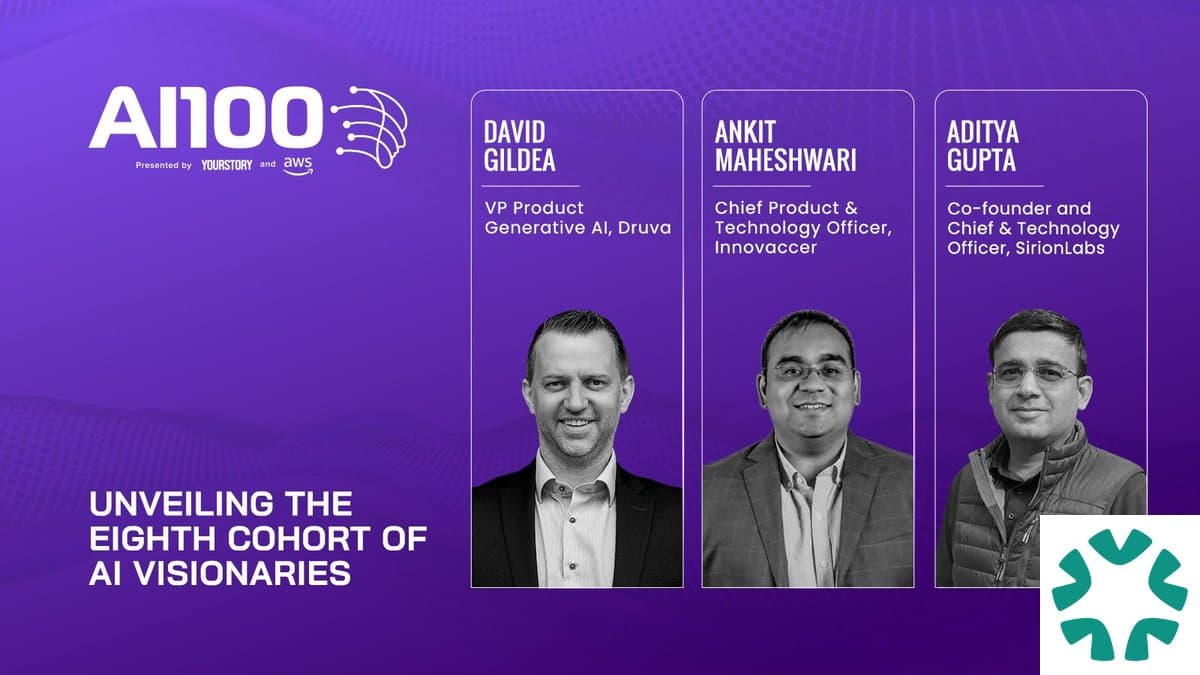
TABLE OF CONTENTS
The shift from standalone AI to enterprise infrastructure
According to YourStory, AI100’s eighth cohort reflects a broader movement where AI is no longer just an exciting feature but a dependable layer integrated into enterprise systems. The emphasis is on solving stubborn problems—such as data security, healthcare fragmentation, and contract management—by embedding AI into the underlying architecture rather than adding it as a standalone tool.
Druva: Simplifying security with AI-driven automation
David Gildea, VP of Product for Generative AI at Druva, leads a team focused on reducing the complexity of enterprise data security. Druva’s platform uses AI to analyze backup data, identify anomalies, and support compliance reviews for standards like ISO and NIST. The system, DruAI, reportedly resolves 68% of customer issues directly, automating tasks like gap identification, cost estimation, and remediation planning.
Gildea’s approach prioritizes safety and transparency. Druva has delayed deploying certain features until security specifications mature, reflecting a cautious stance in cybersecurity. The platform also includes a Managed Detection and Response service to flag suspicious patterns before incidents escalate.
Gildea describes the mission as democratizing data security without compromising enterprise-grade protection, emphasizing clarity and explainability in AI-driven outcomes.
Innovaccer: Connecting healthcare data for smarter care
Ankit Maheshwari, Chief Product and Technology Officer at Innovaccer, addresses healthcare’s long-standing challenge: disconnected data. Innovaccer’s platform unifies patient data, analytics, and longitudinal context to enable actionable intelligence for care teams. The system supports over 80 million patients and is used by seven of the top 10 health systems in the U.S.
Maheshwari’s strategy starts with infrastructure—cleaning and connecting data before layering on AI tools like chatbots. The focus is on reliability, compliance, and seamless integration into clinical workflows to avoid disrupting providers.
Innovaccer originally served horizontal data and analytics needs across sectors like academia and entertainment before pivoting to healthcare after recognizing the industry’s fragmented data problem.
Sirion: Turning contracts into intelligent systems
Aditya Gupta, co-founder and CTO of Sirion, is reimagining contracts as dynamic, AI-powered systems. Founded in 2012, Sirion’s platform breaks contracts into actionable components, enabling obligation tracking, risk analysis, and workflow integration. AI is central to the platform, supporting tasks like clause extraction, drafting, and negotiation.
Gupta’s approach treats AI as a core enabler rather than an add-on. The system aims for high-confidence outcomes (98-99%) by grounding AI decisions in a legal knowledge graph and ontology. Explainability and auditability are critical, ensuring recommendations are traceable and reliable.
Sirion’s work is informed by Gupta’s background in autonomous robotics, where reliability under uncertain conditions was paramount. The platform reflects this by designing for human augmentation rather than replacement, particularly in high-stakes enterprise environments.
What this means
Lazyfounder analysis — our interpretation, not reported fact.
This cohort signals a maturation of AI in enterprise applications. For founders and operators, the stories of Druva, Innovaccer, and Sirion underscore that AI’s most impactful role may not be in standalone tools but in rewiring the infrastructure underneath existing systems. This shift prioritizes reliability, explainability, and domain-specific context over flashy interfaces—key considerations for startups building in sectors like cybersecurity, healthcare, or legal tech. The emphasis on caution, compliance, and human-centric design also serves as a reminder that AI adoption in regulated or high-stakes industries requires more than technical capability; it demands trust and integration into workflows.
Sources
This story is an original summary drafted with AI by Lazyfounder from the reporting listed above and checked by automated validation. Facts are attributed to their original publishers; sections marked as analysis are Lazyfounder's. Where a source is in another language, facts were machine-translated and quotations are reported, not reproduced. Read the original coverage via the links, and see our AI policy and corrections policy.

About the author
Editor, Lazyfounder
Tarun Mottlia edits LazyFounders, covering Indian startups, funding rounds, AI and product launches. Every story on the site is AI-assisted and checked against its cited sources before publication.
More stories by Tarun MottliaGet the LazyFounder Brief
Startup, funding and AI news in a five-minute read. Join the early-access list.
