

Guide
SpaceX Starship Launch, Flight 15: Ship Caught From Orbit, Booster Lost. What Indian Space-Tech Founders Should Take From It
SpaceX's Starship Flight 15 (13 Nov 2026) reached orbit and the ship was caught by the tower; the booster was lost. What it means for Indian space startups.
By Tarun Mottlia · Lazyfounder · Updated
Quick answer: the SpaceX Starship launch on Friday 13 November 2026 ended in a split result. Starship lifted off from Starbase, Texas, on its 15th flight at 4:47 pm local time (5:47 pm ET). The upper stage reached orbit, deployed 26 Starlink V3 satellites and, 22.5 hours after launch, returned to the same site, where the launch tower caught a Starship ship for the first time. The Super Heavy booster was lost: its boostback burn ended early on low fuel mass, an automated abort diverted it offshore and the flight termination system triggered after the landing burn over the Gulf. So a Starship ship has now been caught after an orbital flight, but full reuse of both stages has not happened yet.
- Super Heavy: Starship's first-stage booster.
- Boostback burn: the engine burn that turns the booster back toward its landing site.
- IN-SPACe authorisation: Indian government clearance for non-government space activities.
- NGE: non-government entity.
SpaceX Starship launch, Flight 15: what happened, step by step
Starship Flight 15 (Booster 22, Ship 42) lifted off from Starbase on 13 November, reached orbit, deployed 26 Starlink V3 satellites and was caught by the tower 22.5 hours later; the Super Heavy booster cut its boostback burn short and was lost over the Gulf. Stage by stage:
| Stage | Result | Source |
|---|---|---|
| Liftoff | Friday 13 November, 4:47 pm local (5:47 pm ET), Starbase, Texas; 15th Starship flight | |
| Booster | Boostback burn ended early due to low fuel mass; automated abort diverted it offshore; flight termination system triggered after the landing burn over the Gulf; root cause under investigation | |
| Orbit + payload | Ship reached orbit; deployed 26 Starlink V3 satellites; contact with every satellite | |
| Time in space | Monitored for more than 20 hours; deorbit burn on one Raptor sea-level engine | |
| Ship return | Returned to the same site 22.5 hours after launch; caught by the launch tower arms at Pad 2 at 3:20 pm CST (2120 UTC) on 14 November |
For readers in India, the catch time works out to about 2:50 am IST on 15 November.
Why the ship catch matters more than the booster loss
The new part of Starship Flight 15 is the Starship ship catch: the upper stage came back to the same site it left, 22.5 hours after liftoff, and the tower caught it at Pad 2 for the very first time.
The booster went the other way. This was the first flight on which SpaceX attempted to catch both stages, and it had to abort the plan to catch and reuse the booster. The booster was lost offshore (see table). The root cause of its short boostback burn is under investigation, so the reason is unconfirmed for now.
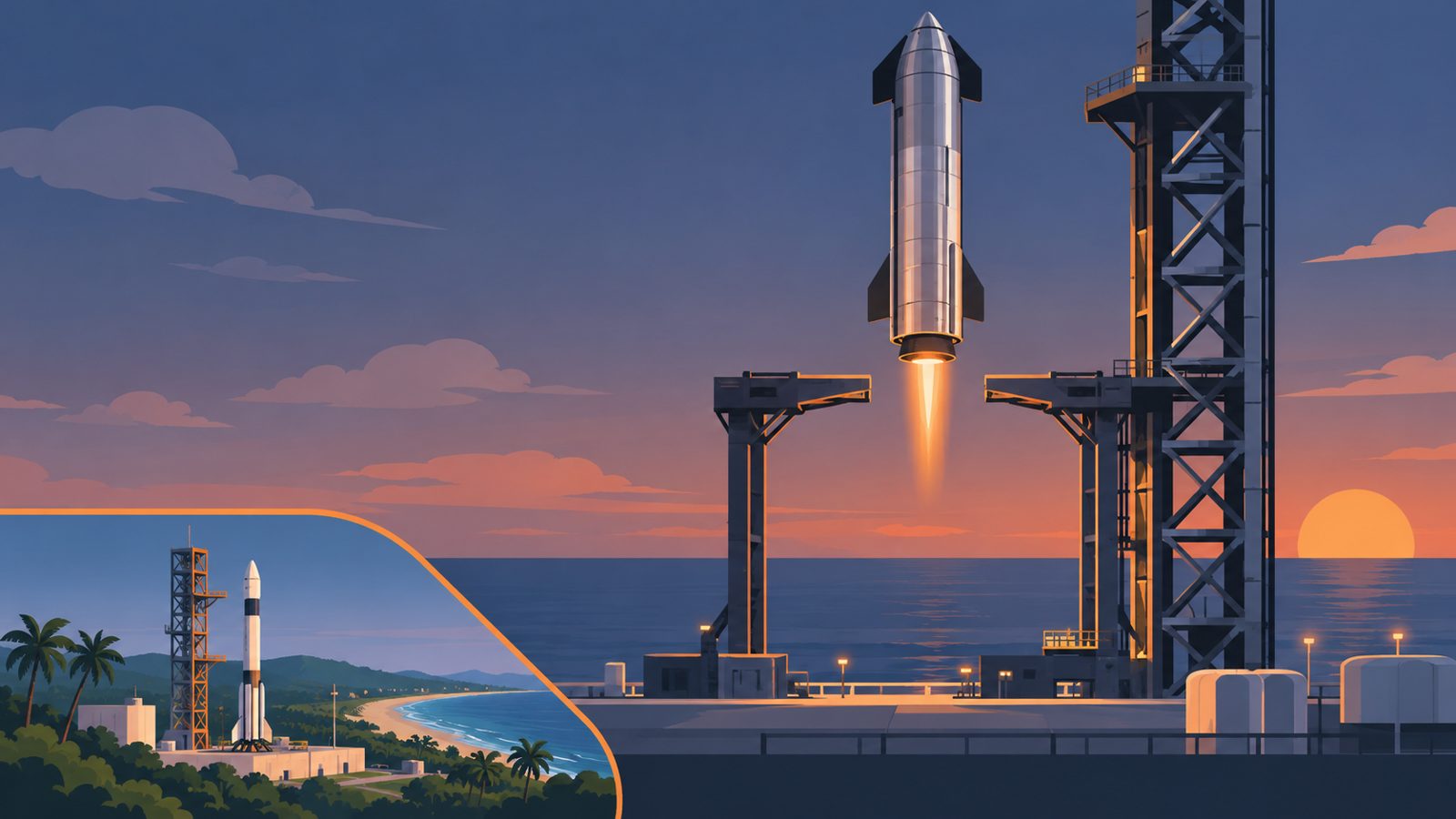
AI-generated illustration.
Where India's private launch startups stand
India already has a private orbital launch. Skyroot Aerospace flew Vikram-1 to orbit on 18 July 2026 from Sriharikota, reaching about 450 km at a 60° inclination; the rocket can lift up to 350 kg to low-Earth orbit, and the follow-on Vikram-2, targeted for 2027, is designed for up to 1,000 kg. In May 2026 Skyroot raised a USD 60 million round, co-led by Sherpalo Ventures and GIC, that valued it at around USD 1.1 billion, took total funding past USD 100 million and is earmarked for launch vehicles, cadence and facilities.
Reusability is the shared direction. Agnikul Cosmos is preparing Mission-02, an attempt to catch a returning booster on an ocean barge — a first for India — and The Week reports that, if Agnikul recovers boosters from the ocean, small-satellite launch prices could fall by almost 80%. Abyom SpaceTech has demonstrated an indigenous reusable liquid rocket engine, and EtherealX is developing reusable rocket architectures.
On regulation, a written Rajya Sabha reply by MoS Jitendra Singh, reported on 13 August 2026, said IN-SPACe had granted 113 authorisations to 52 non-government entities, 18 of them startups — including Agnikul Cosmos, Skyroot Aerospace, Pixxel, Dhruva Space, Digantara and GalaxEye — with roughly 440 space startups registered on Start-up India. The same reply listed two private launches as proposed for FY 2026-27 and more than six as expected in FY 2027-28, with the manifest not yet approved by IN-SPACe.
What Indian space-tech founders can do next
For Indian space-tech founders, the practical takeaways are about timelines and proof: start IN-SPACe authorisation early, plan for few domestic private launch slots, tie each funding ask to a milestone, and present reusability savings as projections until recovery hardware has flown.
(a) Start the IN-SPACe authorisation process early. The numbers suggest authorisation is a bottleneck: 113 authorisations have gone to 52 entities, only 18 of them startups, against roughly 440 registered space startups. Treat the authorisation timeline as a long-lead item in your plan.
(b) Plan for scarce domestic launch slots. With two private launches proposed for FY 2026-27, more than six expected in FY 2027-28, and the manifest not yet approved, satellite and payload startups should assume limited supply and book early.
(c) Pitch a milestone ladder, not a SpaceX comparison. Skyroot raised at about USD 1.1 billion in May 2026, before Vikram-1 flew, with the money earmarked for launch vehicles, cadence and facilities; the orbital flight followed in July. That suggests a deck that ties each funding ask to the milestone it buys is likely easier to underwrite than one that leans on SpaceX.
(d) Quote reusability economics as targets. The "almost 80%" price-cut figure reported for Agnikul is a projection that depends on a booster recovery Agnikul was still preparing to attempt as of July 2026. This Starship flight shows even the sector's leader can miss a step — its booster was lost, root cause under investigation. Until recovery hardware has flown and come back, label cost savings as projections.
This is general information, not legal or investment advice.
This flight moved reusable launch forward on the ship side while the booster side still has open questions. For Indian founders, the useful signal is to plan around authorisations, launch slots and flown milestones rather than headlines. Track the next milestones on the Skyroot Aerospace and Agnikul Cosmos pages.
FAQ
Did Starship Flight 15 succeed? Partly. The ship hit its main marks — orbit, 26 Starlink V3 satellites deployed with contact on all of them, and the first tower catch of a returning ship. The booster was lost after its boostback burn ended early.
Was the Super Heavy booster caught? No. Its boostback burn ended early and SpaceX aborted its plan to catch and reuse it.
When did Starship land in IST? The catch happened at 3:20 pm CST (2120 UTC) on 14 November, about 2:50 am IST on 15 November.
Has an Indian private rocket reached orbit? Yes. Skyroot Aerospace's Vikram-1 reached orbit on 18 July 2026 from Sriharikota, at roughly 450 km and 60° inclination.
How many Indian space startups hold IN-SPACe authorisation? 18 startups, among 52 non-government entities holding 113 authorisations, per the Rajya Sabha reply reported on 13 August 2026.
Sources
- SpaceX — Starship Flight 15 mission update — fetched 15 November 2026
- CNBC — SpaceX launches Starship in key test flight (13 Nov 2026) — fetched 15 November 2026
- Spaceflight Now — Starship Flight 15 live coverage — fetched 15 November 2026
- Telangana Today (IANS) — Rajya Sabha reply by MoS Jitendra Singh on space startups and IN-SPACe authorisations (13 Aug 2026) — fetched 15 November 2026
- Via Satellite — Skyroot Aerospace makes history for India with first launch success (20 Jul 2026) — fetched 15 November 2026
- Entrepreneur India — Skyroot USD 60 Mn round (7 May 2026) — fetched 15 November 2026
- The Week — India's private space startups after Vikram-1 (20 Jul 2026) — fetched 15 November 2026
I'm Tarun, founder of LazyFounder. This page was drafted with AI from the sources listed above and checked against them. See our editorial policy.
Related reading: SpaceX · Skyroot Aerospace · Agnikul Cosmos · IN-SPACe · ISRO